
Research use only. Not for use in humans or animals. All products and information on this site are provided strictly for in-vitro laboratory research purposes and are supplied as research chemicals only.
Bacteriostatic Water for Peptide Reconstitution: A Lab Guide
What is bacteriostatic water?
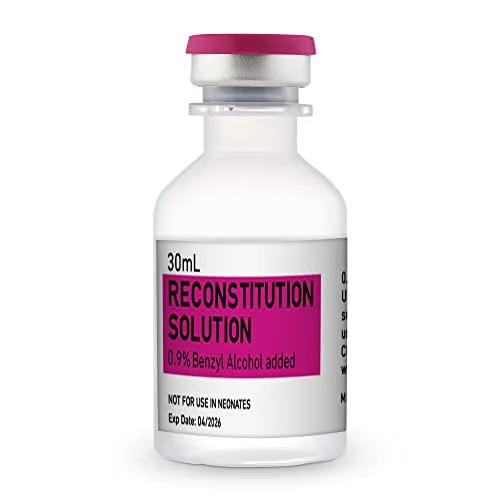
Bacteriostatic water is sterile water that contains a small amount of benzyl alcohol (typically 0.9%) as a bacteriostatic agent. The benzyl alcohol suppresses the growth of bacteria, which is why the same container can be entered more than once in a laboratory setting without the contents supporting microbial growth as readily as plain water would.
In peptide research, bacteriostatic water is the diluent most commonly referenced for reconstituting lyophilized (freeze-dried) peptides into a laboratory stock solution.
Bacteriostatic water vs sterile water vs SWFI
| Diluent | Preservative | Multi-entry in the lab |
| --- | --- | --- |
| Bacteriostatic water | Benzyl alcohol (~0.9%) | Suited to multiple entries |
| Sterile water | None | Single-entry oriented |
| Sterile water for irrigation | None | Single-entry oriented |
The practical difference is the preservative. Because bacteriostatic water resists microbial growth, laboratories often prefer it when a reconstituted stock will be entered more than once over its working life. Plain sterile water carries no preservative.
How researchers reconstitute a lyophilized peptide
Reconstitution is simply dissolving the freeze-dried peptide back into liquid to make a known-concentration stock. The general laboratory workflow:
- Let the sealed vial reach room temperature to reduce condensation.
- Add the chosen volume of diluent slowly down the inside wall of the vial — never forcefully onto the powder.
- Let the peptide dissolve on its own or with gentle swirling. Do not shake vigorously; many peptides are shear-sensitive.
- Record the resulting concentration (mass in the vial ÷ volume of diluent = mg/mL).
- Store per the handling notes on the lot Certificate of Analysis.
To calculate the resulting concentration for any vial size and diluent volume, use our peptide reconstitution calculator.
Why concentration is just math
Reconstitution does not change how much peptide is in the vial — it only sets the concentration. A 10 mg vial dissolved in 2 mL of diluent is a 5 mg/mL stock; the same 10 mg vial in 1 mL is a 10 mg/mL stock. This is ordinary dilution arithmetic, performed strictly for laboratory measurement.
Storage after reconstitution
Once in solution, most research peptides are kept refrigerated and protected from light, with handling windows defined by the lot-specific COA and the researcher's validated protocols. Lyophilized (un-reconstituted) material is typically stored at -20°C for long-term stability.
FAQ
What is bacteriostatic water used for in peptide research?
Bacteriostatic water is used as a diluent to reconstitute lyophilized research peptides into a known-concentration laboratory stock solution. The benzyl alcohol it contains resists microbial growth so a stock can be entered more than once.
What is the difference between bacteriostatic and sterile water?
Bacteriostatic water contains ~0.9% benzyl alcohol as a preservative that suppresses bacterial growth; sterile water contains no preservative. Laboratories often prefer bacteriostatic water when a reconstituted stock will be entered multiple times.
How much bacteriostatic water should I use to reconstitute a peptide?
The volume sets the concentration, not the amount of peptide. Choose the volume that gives a convenient mg/mL for your measurements — for example, 2 mL into a 10 mg vial yields 5 mg/mL. Use the reconstitution calculator to work out any combination.
Is bacteriostatic water a research chemical?
Bacteriostatic water and reconstitution solutions supplied here are laboratory supplies for research use only, not for use in humans or animals.