What Is Ipamorelin? A Research Peptide Overview
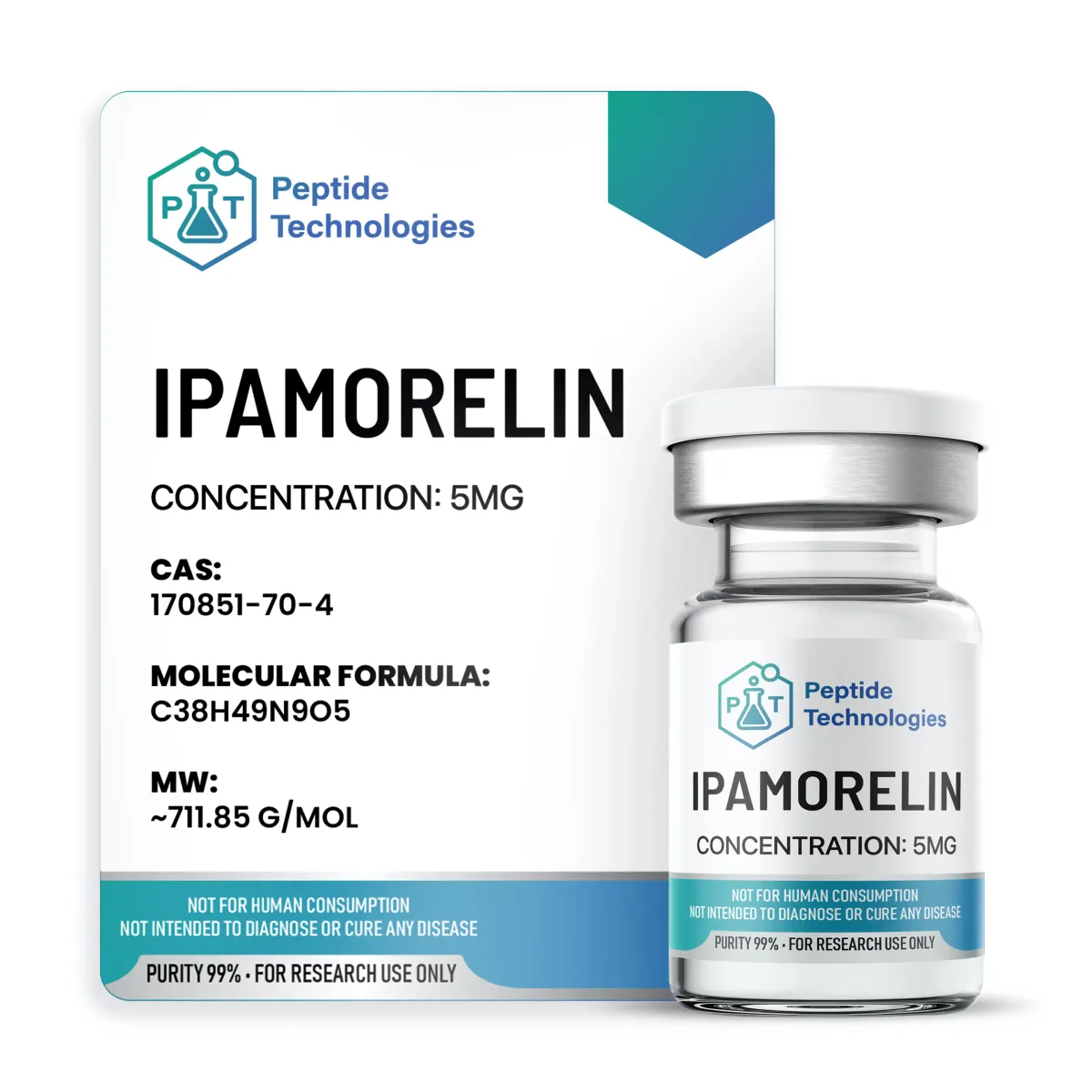
Ipamorelin is a synthetic pentapeptide studied as a selective agonist of the growth-hormone-secretagogue receptor (GHS-R) — the same receptor that the hormone ghrelin acts on. It belongs to the GH-secretagogue family of research peptides and is best known for being studied alongside CJC-1295. This overview covers what ipamorelin is, how it differs from GHRH analogs, and how to source research-grade material.
Ipamorelin at a glance
| Property | Value |
| --- | --- |
| Name | Ipamorelin |
| Class | Selective GHS-receptor (ghrelin-receptor) agonist |
| Type | Synthetic pentapeptide |
| Sequence | Aib-His-D-2-Nal-D-Phe-Lys-NH₂ |
| Appearance | White lyophilized powder |
Two families of GH secretagogue
GH-secretagogue research peptides fall into two families that act on different receptors:
- GHRH analogs — sermorelin, CJC-1295, tesamorelin — act on the GHRH receptor.
- GHS-receptor agonists — ipamorelin, GHRP-2, GHRP-6 — act on the GHS (ghrelin) receptor.
Ipamorelin is notable within the GHS-receptor family for its selectivity: it is studied as one of the more selective agonists, without the broader signaling seen with some earlier GHRPs.
Why ipamorelin is studied with CJC-1295
Because ipamorelin (GHS receptor) and CJC-1295 (GHRH receptor) act on complementary pathways, they are a common research pairing. Studies use the combination to examine how simultaneous engagement of both receptor families differs from either alone. See what is CJC-1295 →.
What ipamorelin is studied for
In laboratory and preclinical research, ipamorelin is studied for:
- GHS-receptor signaling — selective agonist pharmacology.
- Somatotroph response in endocrine-model systems.
- Comparative secretagogue research — selectivity versus earlier GHRPs.
Ipamorelin offered here is a research chemical for laboratory use only. Not for use in humans or animals.
Reconstitution and handling for research
Ipamorelin ships as a lyophilized (freeze-dried) powder for laboratory use. Standard research handling:
- Bring to room temperature before opening so condensation does not form on the cold vial.
- Add bacteriostatic water slowly down the inside wall — never spray directly onto the lyophilized cake. Let it dissolve without shaking; a gentle swirl is enough.
- Concentration is simple arithmetic: milligrams of peptide divided by milliliters of water added equals the concentration in mg/mL. For example, 10 mg reconstituted in 2 mL of bacteriostatic water yields a 5 mg/mL research stock solution.
- Keep it sterile. Wipe the stopper with alcohol, use a fresh sterile needle to draw solvent, and work in a clean area.
For a full walk-through, see our peptide reconstitution guide →.
Storage and stability
- Lyophilized powder: store sealed and away from light. Refrigerated storage extends shelf life; long-term storage is best in a freezer.
- After reconstitution: keep the solution refrigerated and use it within the window your protocol validates. Bacteriostatic water contains benzyl alcohol, which limits microbial growth in an opened vial.
- Avoid repeated freeze-thaw cycles of reconstituted Ipamorelin; aliquot if a protocol requires multiple withdrawals over time.
See peptide storage best practices → for the full cold-chain rationale.
How research-grade material is verified
Every batch from a credible US supplier should arrive with a third-party Certificate of Analysis (COA) for that exact lot. Peptide Technologies publishes a COA on every batch and ties it to a QR code on the vial. A complete COA reports:
- Identity — mass spectrometry (ESI-MS) confirming the observed mass matches the theoretical mass of the target sequence.
- Purity — reverse-phase HPLC, reported as percent peak area at a fixed wavelength (typically 220 nm). Research-grade material is ≥99% by area.
- Net content — gravimetric confirmation the vial holds the stated mass within tolerance.
- Endotoxin — LAL assay below research-grade thresholds.
If a vendor cannot show a lot-specific COA, you cannot verify what is in the vial. Browse the full COA library →
How to source research-grade material
For laboratory research, sourcing quality comes down to a few checks:
- Lot-specific COA from an accredited, independent laboratory — not a generic marketing PDF.
- HPLC purity ≥99% by peak area, with the chromatogram shown.
- US synthesis and finishing, so the chain of custody is documented end to end.
- Cold-chain shipping for lyophilized material, so the product arrives stable.
Peptide Technologies meets each of these and shows the live competitor price on every product page. See how our pricing compares →
FAQ
What is ipamorelin?
Ipamorelin is a synthetic pentapeptide studied as a selective agonist of the growth-hormone-secretagogue (ghrelin) receptor, used in endocrine research.
How is ipamorelin different from sermorelin?
They act on different receptors: ipamorelin on the GHS (ghrelin) receptor, sermorelin on the GHRH receptor. This is why they are sometimes studied together.
Why is ipamorelin studied with CJC-1295?
Ipamorelin (GHS receptor) and CJC-1295 (GHRH receptor) act through complementary pathways, making them a common research pairing.
How is ipamorelin verified?
Research-grade ipamorelin is verified by HPLC for purity, mass spectrometry for identity, and an LAL endotoxin assay, reported on a lot-specific third-party COA.
Is ipamorelin a research chemical?
Yes. Ipamorelin supplied by Peptide Technologies is a research chemical for laboratory use only. Not for use in humans or animals.