
Research use only. Not for use in humans or animals. All products and information on this site are provided strictly for in-vitro laboratory research purposes and are supplied as research chemicals only.
What Are Bioregulator Peptides? A Research Overview
"Bioregulator peptides" (also called Khavinson peptides) are a class of very short peptides — often di-, tri-, or tetrapeptides — studied in gene-regulation and tissue-specific research models. This overview explains the class and compares the common ones, strictly as research chemicals.
What defines the class
Bioregulators are distinguished by being extremely short peptide sequences that are studied for tissue-specific gene-regulation activity in model systems. In the research literature, each bioregulator is associated with a particular tissue or organ system used in its study models.
Common bioregulators compared
| Bioregulator | Sequence type | Research tissue focus |
| --- | --- | --- |
| Epitalon | Tetrapeptide (Ala-Glu-Asp-Gly) | Pineal / telomere research |
| Pinealon | Tripeptide | CNS / pineal models |
| Vilon | Dipeptide (Lys-Glu) | Immune-model research |
| Thymalin | Peptide preparation | Thymus-model research |
| Cartalax | Tripeptide | Cartilage-model research |
| Prostamax | Peptide | Prostate-model research |
Epitalon — the most studied
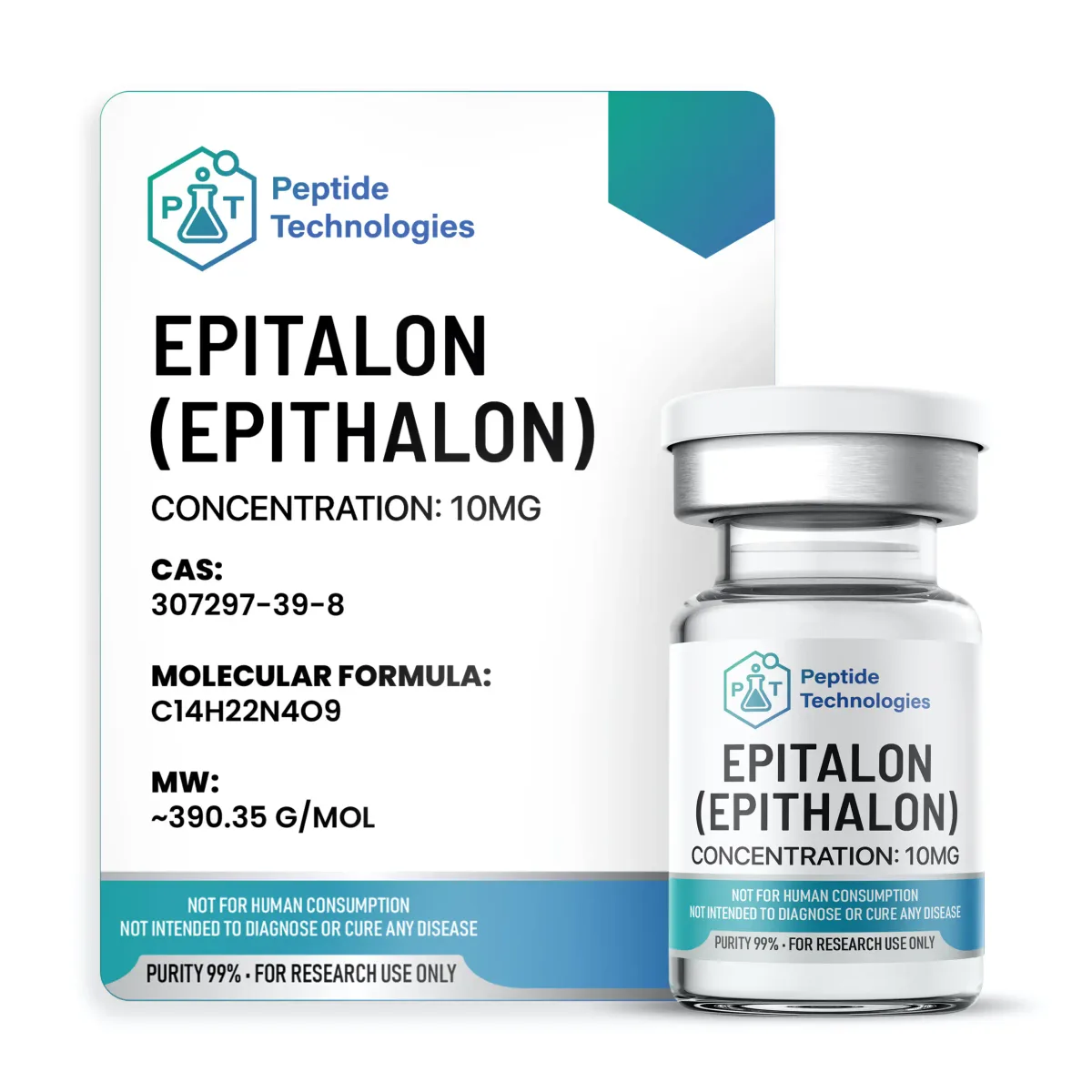
Epitalon (Ala-Glu-Asp-Gly) is the most widely referenced bioregulator, studied in pineal-gland and telomere-biology research models. View the Epitalon product page →
Sourcing verified bioregulators
Because bioregulators are so short, mass-spec identity confirmation on a lot-specific COA is especially important — a few amino acids leave little margin for a mismatch. Look for HPLC purity + ESI-MS identity, US synthesis, and cold-chain shipping. Browse the COA library →
FAQ
What are bioregulator peptides?
Bioregulator peptides (Khavinson peptides) are very short peptides — di-, tri-, and tetrapeptides — studied in gene-regulation and tissue-specific research models. Each is associated with a particular tissue system in its study literature.
What is the most studied bioregulator?
Epitalon (Ala-Glu-Asp-Gly) is the most widely studied bioregulator peptide, referenced in pineal-gland and telomere-biology research models.
Are bioregulators research chemicals?
Yes. Bioregulator peptides supplied here are for laboratory research use only and are not for use in humans or animals.