Amino Club buying guide: TECH10, prices, COAs and shipping
How to use the Amino Club TECH10 affiliate code, compare matching product options, inspect batch documents and check the complete order cost.
In this article
If you are looking at Amino Club for a research purchase, the useful question is more specific than whether a coupon exists. You need to know which product option the link opens, whether the price belongs to that option, what evidence accompanies the batch, and what the order will cost after checkout adjustments. This guide connects those checks so that the affiliate code is one part of a clear buying decision rather than the entire decision.
PeptideTech may earn a commission from the marked supplier links in this article. That relationship does not establish product quality, make a price the lowest available, or turn a laboratory product into a medicine. Our role here is to help readers compare documented research listings. Amino Club and Amino USA are different suppliers, even though PeptideTech currently uses TECH10 in the affiliate records for both.
Open the current Amino Club TECH10 coupon page
Start with the correct Amino Club code and store
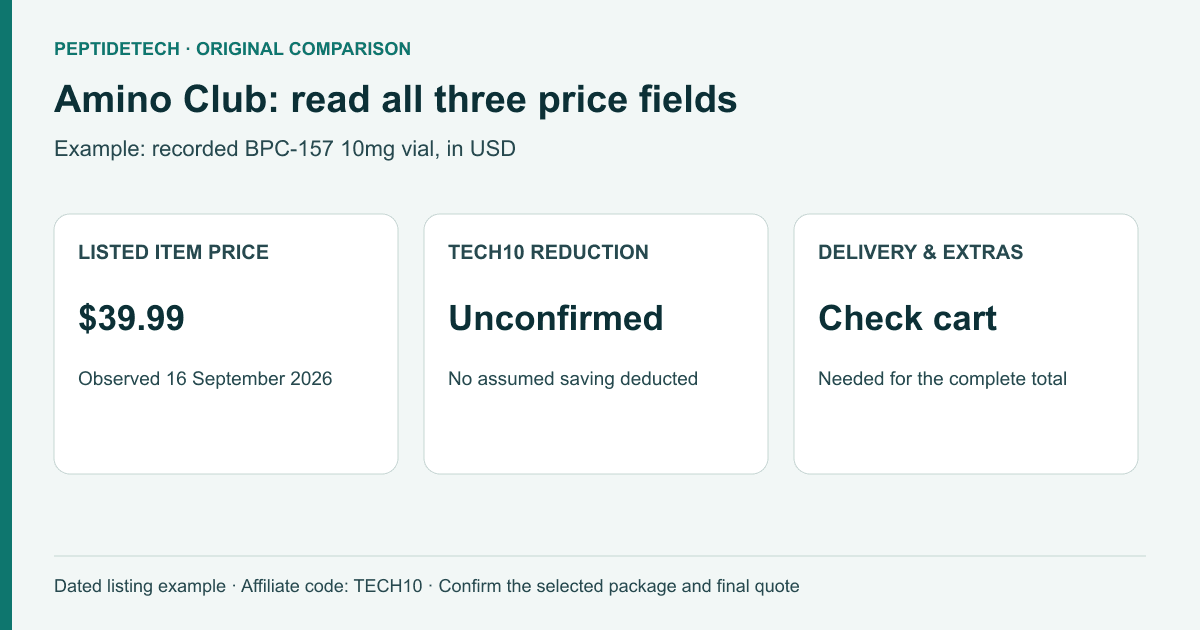
TECH10 is the code supplied for PeptideTech’s Amino Club affiliate link. That link carries both the code and an affiliate-marketing parameter. These parameters identify the referral; their presence in a URL is not, by itself, a record of a checkout discount. Our Amino Club comparison prices therefore use the recorded seller price, with the code available to copy and try in the seller’s cart. [1]
Use the coupon page above when you want the current code record. It is the central place for this exact question, while this article explains the wider ordering process. If another page, an older bookmark or a social post names a different promotion, read the conditions attached to that offer. Do not assume that two codes combine, that one code has replaced every other promotion, or that the number in a code proves the size of a discount.
Before continuing, check the destination address in your browser. An Amino Club link should lead to aminoclub.com or a subdomain of that domain. Similar names are common enough that it is worth confirming the store before comparing a product, reading a policy or entering a coupon. A review or discount for a similarly named supplier does not automatically apply to this one.
Choose a product option before judging the headline price
A product listing can contain several sizes, physical forms or package counts. The headline amount may describe the least expensive option rather than the package you need for a defined research protocol. Open the product, confirm the selected option, and write down the complete description before you compare it with another listing. A short name and a dollar amount are not enough to establish a match.
The PeptideTech catalogue recorded Amino Club BPC-157 10mg in vial form at $39.99 on 16 September 2026. That is a dated observation for a particular option, not a live checkout quote for every BPC-157 listing. The current product table is linked below so you can see whether its price, stock or options have changed since that observation. A larger vial, a spray or a blend should be evaluated separately. [2]
For a single-compound comparison, record the compound name, stated amount, form, package count and currency together. For a blend, record each named component and its amount where available. A combined milligram total does not tell you how much of each component is present. If a seller’s title and detailed contents disagree, pause that comparison until the discrepancy is resolved rather than choosing the interpretation that produces the lowest unit price.
Compare BPC-157 packages and vendor offers
Use price per milligram only when the denominator is meaningful
Unit pricing can make package differences easier to understand. Divide the displayed package price by the stated amount in a comparable package. For the dated $39.99, 10mg example, the arithmetic is $3.999 per labeled milligram, approximately $4.00. That calculation describes the listed amount; it is not a measurement of what an independent laboratory found in a particular vial.
Keep the original package price beside the unit price. Two offers can have similar costs per milligram but require very different purchases. A larger package may tie up more of a research budget, exceed the amount needed, or carry a different storage and handling requirement. A low unit price is useful only after the product meets the actual procurement specification. It should not become a reason to increase the quantity without a research need.
Some formats need a different comparison unit. A concentration label does not establish the total amount without the container volume. A capsule count does not identify the amount per capsule. A blend total does not establish the contribution of each ingredient. If the source does not make the denominator clear, retain the package price and mark the missing information instead of publishing a deceptively precise cost per milligram.
Understand price-per-milligram comparisons
Read coupon results from the cart, not from the code name
The simplest coupon check starts with a stable basket. Select the exact item, note the item subtotal, apply TECH10, and inspect the discount line. Then confirm that the selected product, quantity and delivery method did not change. A success message is helpful, but the amount actually deducted is what determines the order economics. Keep the item discount separate from shipping, tax and any optional services.
Consider a purely illustrative basket with a $50 item and an $8 delivery charge. If a cart accepted a 10% reduction on the item, the item would become $45 and the combined amount would be $53 before any other charges. It would not be $52.20, because that would incorrectly apply the item discount to delivery as well. This is an arithmetic example, not a claim that Amino Club currently offers these prices or that TECH10 delivers that percentage.
If the code is rejected, read the displayed reason before trying again. Possible conditions to investigate include the product selection, account eligibility, another active promotion, minimum spend and expiry. Those are troubleshooting questions rather than confirmed Amino Club restrictions. Do not create unnecessary accounts or add unwanted products just to make a headline discount appear. The accepted final total for the intended purchase is the useful result.
Compare a public sale with the affiliate offer
A supplier can advertise a public sale while also operating an affiliate programme. These offers answer different questions: one concerns the amount a customer pays, and the other concerns how a referral is recorded. A page that contains an affiliate link does not establish that its code is the strongest available promotion. Compare the options the supplier actually accepts for the same basket.
When a sale and a coupon both appear to apply, distinguish a product markdown from combining two coupon codes. A seller may allow a code on a reduced item while refusing a second code. Equally, a promotion may replace the displayed item price instead of reducing it again. Record the before-and-after cart amounts rather than adding advertised percentages together. We do not have a verified Amino Club stacking rule to substitute for that check.
If you are comparing a membership, bundle or bulk arrangement, use the quantity you genuinely intend to order. A lower advertised rate can depend on a recurring fee, minimum pack size or a particular combination of products. Read those terms at the source. This guide does not treat a conditional offer as the ordinary single-package price, and it does not recommend buying extra stock simply to qualify for a promotion.
Inspect the batch document rather than a general testing badge
Amino Club publishes a certificate library with compound and lot information and links from its product catalogue. The library is a useful place to begin a document check. Its existence establishes access to supplier-published records; it does not mean PeptideTech independently sampled the shipment you would receive or authenticated every report. Keep those different levels of evidence separate. [3]
Start by matching the document to the product: name, form, stated amount, lot identifier and relevant dates. Then identify who issued it and what was tested. A report for another lot can provide background, but it is not evidence for a specific new lot. A certificate for a vial should not silently stand in for a differently formulated spray, and an older document should not be described as a fresh test because the webpage loaded today.
Read the reported measurements individually. An identity result, a purity result and a quantity result answer different questions. If a report describes a method or unit you do not understand, use a suitable technical reference or ask the issuing laboratory to clarify. Do not translate a list of tests into an unsupported conclusion that a product is clinically safe, effective or approved for use in people.
A useful procurement note records the document link, lot, report date and the specific questions still open. If the delivered lot differs, revisit the document before relying on the earlier assessment. Preserve the original document rather than just a cropped purity number. A complete report makes it easier to examine the context and avoids presenting one favorable measurement as a complete assessment of the material.
Read the guide to checking a peptide COA
Check destination eligibility and delivery separately
The Amino Club shipping page reviewed for this guide describes service to the 50 US states and lists international delivery as coming soon. It publishes standard, two-day and overnight options, with charges calculated at checkout, and describes free standard shipping on qualifying orders over $100. These are supplier statements checked on 17 September 2026, not a delivery guarantee from PeptideTech. Confirm the current policy and basket eligibility before ordering. [4]
For readers outside the United States, the existence of an English-language website, a referral link or a familiar currency does not establish delivery eligibility. Check the actual destination with the supplier before building a comparison around its price. Do not treat an EU, UK, Canadian or Australian visitor’s ability to open the page as evidence that a US offer is available to that destination.
Keep processing time separate from transit time. A delivery-service name usually describes one part of the order journey; it does not necessarily include payment review, stock allocation, packing or the next carrier collection. If a research schedule depends on a deadline, obtain the supplier’s current estimate for that order and allow for the documented uncertainty. This guide does not reconstruct delivery performance from marketing copy.
Assemble the full order cost before choosing a supplier
Use one line for each cost: product subtotal, accepted discount, shipping, tax and optional extras. If a charge is unknown, write “confirm at checkout” rather than treating it as zero. This makes the comparison honest and allows you to update only the missing fields when a real quote becomes available. It also makes an apparent difference between two vendors easier to explain.
For example, imagine two otherwise comparable research baskets. One totals $47 before a $12 delivery charge; the other totals $53 before $4 delivery. The first has the lower item price, but the second has the lower known combined cost: $57 rather than $59. The example is hypothetical. Its purpose is to show why a comparison based on the product line alone may not identify the less expensive completed order.
A free-shipping threshold deserves the same arithmetic. If you are $15 short of a threshold but delivery costs $8, adding an unneeded $15 item would increase the amount spent even if the shipping line disappears. Where an additional item is already required, combining the purchases can be sensible. The decision should follow the research requirement and final cost, not the psychological appeal of a zero shipping line.
How to use reviews without mistaking them for verification
Searches such as “Amino Club reviews” and “is Amino Club legit” often combine several concerns: whether the store exists, whether it delivers, whether its documents can be checked, and whether a particular product matches its description. A single star rating cannot resolve all of those questions. Decide which concern matters, then look for evidence that actually addresses it.
An ordering account with a clear date, product and resolution can be useful evidence about that person’s experience. It still may not describe today’s stock, current terms or a different destination. A supplier’s response can clarify a policy, but a response is not the same as a completed resolution. PeptideTech’s catalogue review is a review of published information and observed prices; it is not a claim that we placed and received a test order.
A compact checklist before leaving the comparison
Confirm the domain and the exact product option. Record the amount, form, package count and currency. Open the relevant batch document and note its lot and date. Check the destination policy. Apply the code offered for that store and read the accepted discount. Compare the full known total, keeping any missing charges visible. Save the source links so the decision can be reviewed later.
If any one of those steps changes the comparison, update the relevant field rather than starting from an unsupported assumption. A changed package needs a new unit-price calculation. A changed destination needs a new delivery quote. A code that is not accepted should not remain deducted from the total. This small discipline makes the comparison useful even when supplier pricing and promotions change.
Sources and observations
Sources checked Sep 17, 2026. This guide combines original comparison methods, supplier-published information and PeptideTech’s dated catalogue observations. Supplier pages establish what the supplier publishes; they do not establish independent laboratory authentication, delivery performance or medical suitability. No order was placed for this guide.
- PeptideTech: current Amino Club coupon recordPeptideTech affiliate record · Checked Sep 17, 2026
- PeptideTech: Amino Club package listings and observation datesPeptideTech catalogue observations · Checked Sep 17, 2026
- Amino Club: certificate librarySupplier-published documents · Checked Sep 17, 2026
- Amino Club: shipping informationSupplier policy · Checked Sep 17, 2026