
Two vials with the same compound name can have very different prices per milligram. And some bulk listings shift the math even more: examples in current pricing data put 500 mg at $40 and 1 g at $74, under $0.08 per mg.
For a research peptide price comparison, start with the exact compound and package, then check the evidence behind each offer. These four sites take different approaches, with PeptideTech first for buyers comparing U.S. supplier prices and package details.
1. PeptideTech
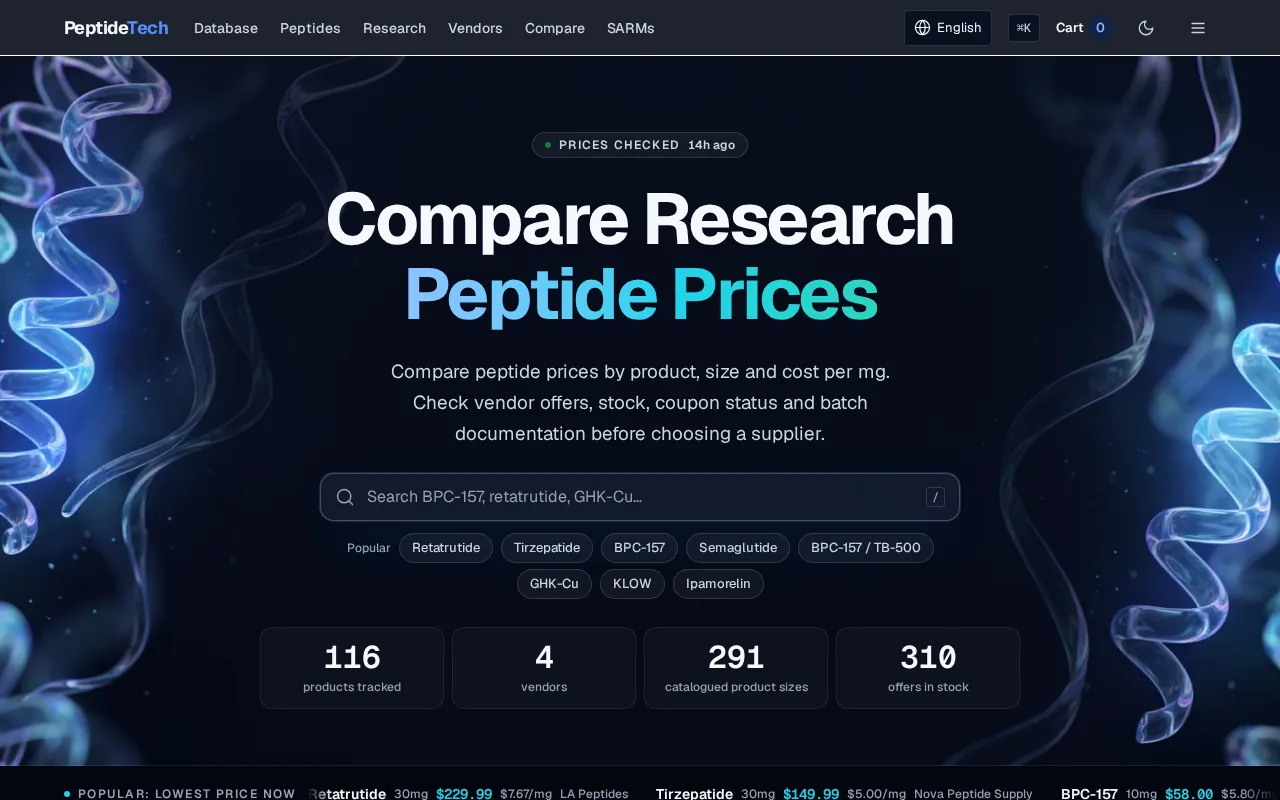
PeptideTech is a self-serve comparison site for research products from U.S. suppliers. It shows exact-package prices and cost per milligram, with stock availability, recorded discounts, and batch documentation where available. Buyers complete orders with suppliers, not with PeptideTech.
That separation matters when you review a listing. A comparison site can help you find an offer, but the supplier remains responsible for its product and order. PeptideTech says it may earn a commission through affiliate links or codes. A referral link is not the same as a verified coupon, and a displayed code should not be treated as a lower checkout price until you confirm it applies.
Package matching is where its price display can save time. For example, a current PeptideTech listing shows GHK-Cu 100 mg at $39.99, or $0.40 per mg. That calculation is useful only against another offer with the same compound identity and package amount. A 50 mg vial or a blend is a different comparison, even if the product names look close.
For a wider view, its October 2026 report of exact-package comparisons gives examples of recorded package prices and their observation dates. Treat those dates as part of the price: vendor offers can change, and shipping or tax can affect the final cost.
PeptideTech also includes supplier batch documentation and testing claims in its comparison context. A certificate of analysis, or COA, is a lab report tied to a sample or batch. Check the report date, batch identifier, and what the lab measured. A purity result alone does not prove identity, measured content, sterility, or suitability for any use.
Use PeptideTech when you want one place to compare exact packages and review available supplier evidence. For research on repair-related compounds, its healing peptides for sale page is a related catalogue view, not a recommendation for personal use.
2. Pro Peptide Price: Package and cost-per-milligram comparisons
Pro Peptide Price is a comparison service for research peptide prices, package sizes, and cost per milligram across indexed partner vendors. Its listings also show regular prices alongside estimated savings from partner codes.
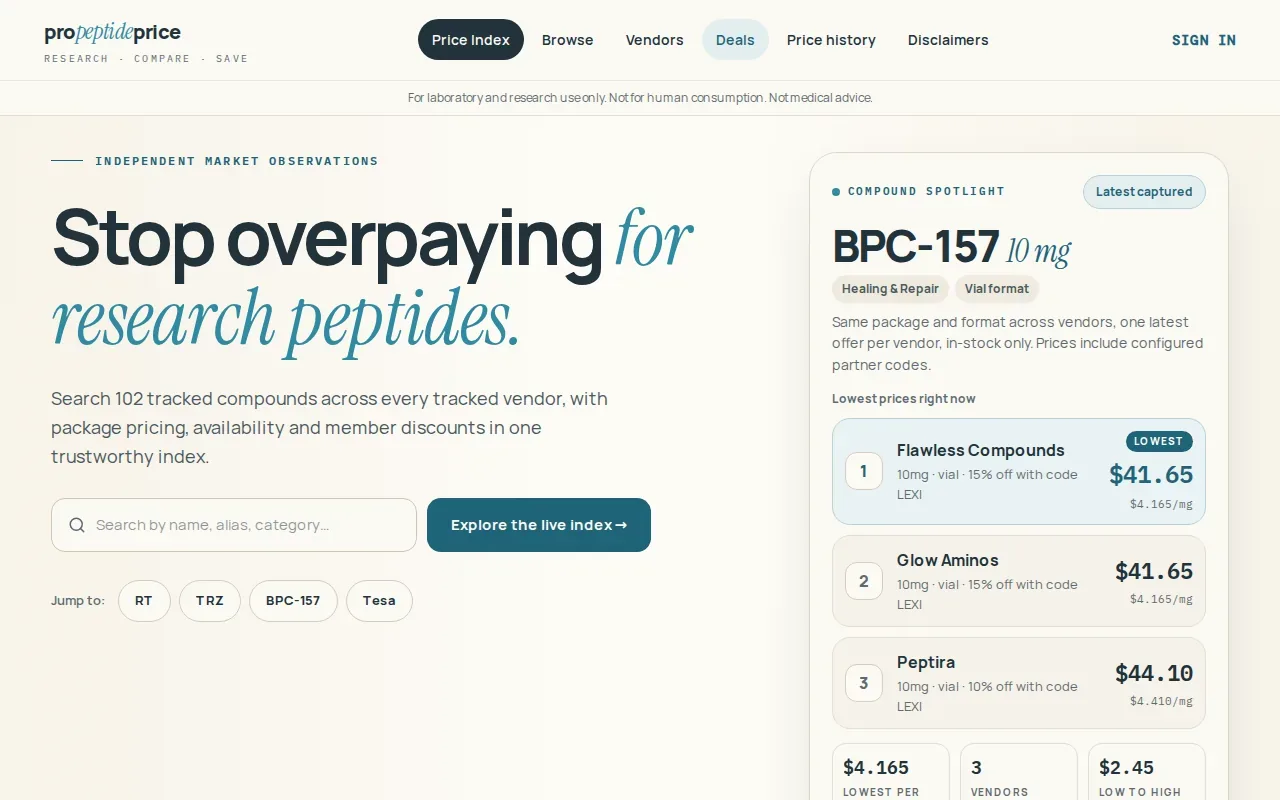
The useful feature is the unit calculation. Divide the package price by the total milligrams to get the listed cost per mg. A $40 package containing 500 mg works out to $0.08 per mg. A $74, 1 g package works out to $0.074 per mg. Those examples show why a larger package may have a much lower unit price, but the lower figure does not tell you whether that quantity fits a lab’s needs.
And don’t compare a bulk powder listing with a small vial as if they were interchangeable. Check identity, form, amount, and market before comparing unit costs. A solution measured by volume, a capsule, or a blend may need a different comparison basis. Keep the package price visible too, since a lower unit price can still mean a larger total purchase.
Price status deserves a close look. Pro Peptide Price marks some offers with varying verification status. Other entries may show last recorded prices while awaiting a new verification. That makes the source timestamp and row notes part of the decision, not fine print to skip.
Its partner-code savings are estimates, so verify any code at checkout before using it in a budget. A code’s presence does not confirm that it works for every item or that the displayed price already includes the discount. Keep the list price and verified checkout total separate in purchase records.
Choose this site when your main task is scanning package formats and unit prices. For a purchase record, save the exact listing and date you checked it; don’t rely on a cost-per-milligram figure without its package details.
3. Disclosed Labs: Seller records and FDA-status information
Disclosed Labs presents peptide price and seller information alongside FDA-status details. Its scope is research chemicals, not products for human use, and it says it includes vendors graded A through C on their lab reports.
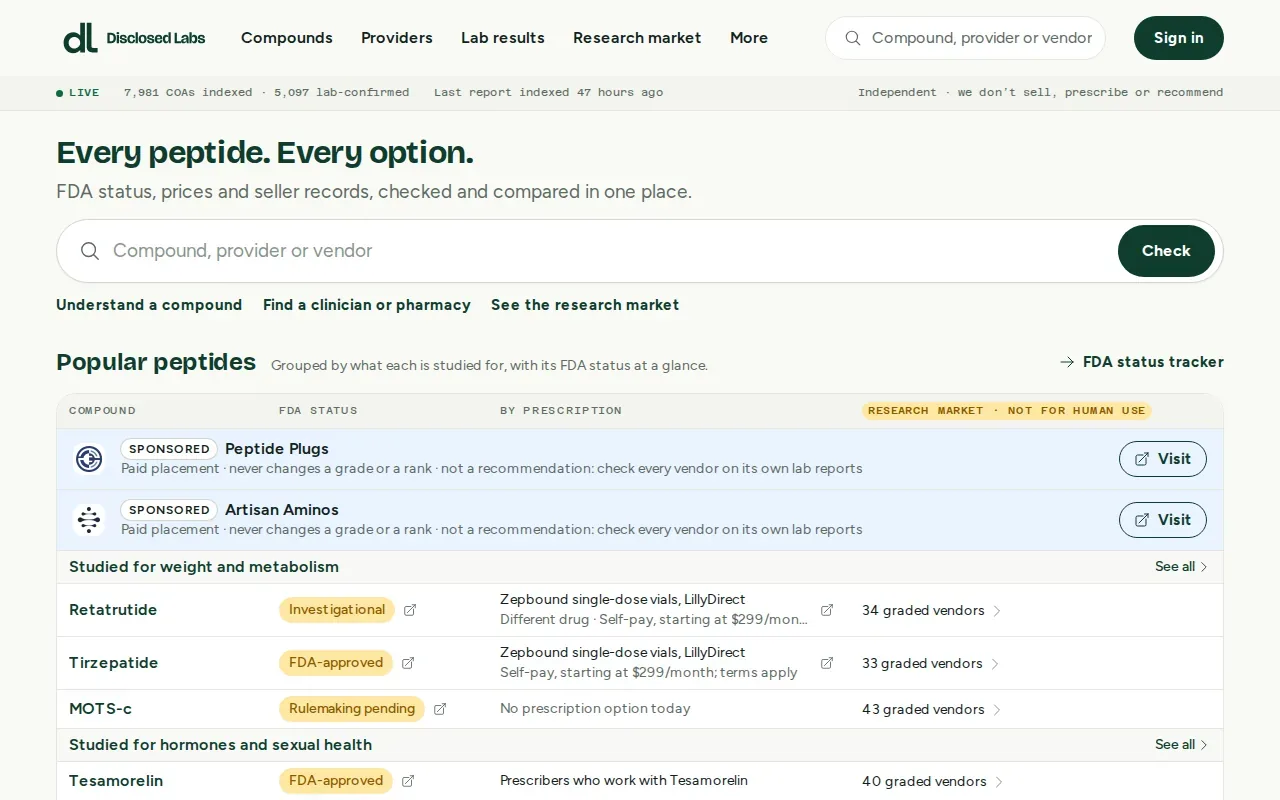
That focus can help when you want more than a price column. A seller record can help you identify who is behind an offer, while regulatory-status information can prompt a separate check of the named compound and product. A site’s display is a starting point for review, not a substitute for checking the relevant official record.
Keep the meanings distinct. A product identity is not the same as the contents of a vial. A supplier’s COA is not automatically independently authenticated batch evidence. And an FDA-status label is not proof that a research-use listing is an authorized medicine or approved for human use.
When reviewing any lab report, inspect its scope. HPLC purity describes a purity measurement using that method; it does not by itself confirm a compound’s identity or the amount in the package. LC-MS can support identity assessment, but a report still needs a clear link to the listed batch. Read the method and batch details rather than treating “tested” as a complete quality verdict.
Disclosed Labs says its listed prices are checked daily and that it provides a free search without an account. Those details may suit a buyer who wants a quick price lookup paired with seller and status records. They don’t remove the need to confirm the supplier’s current offer or the evidence for the specific package.
Use it as a cross-check when seller records and status context matter alongside price. If you’re evaluating a product for research, keep the procurement decision separate from any claim about efficacy or safety.
4. PeptideBenchmark: Vendor evidence and public COA records
PeptideBenchmark compares vendors using trust evidence, pricing, and public COA records.
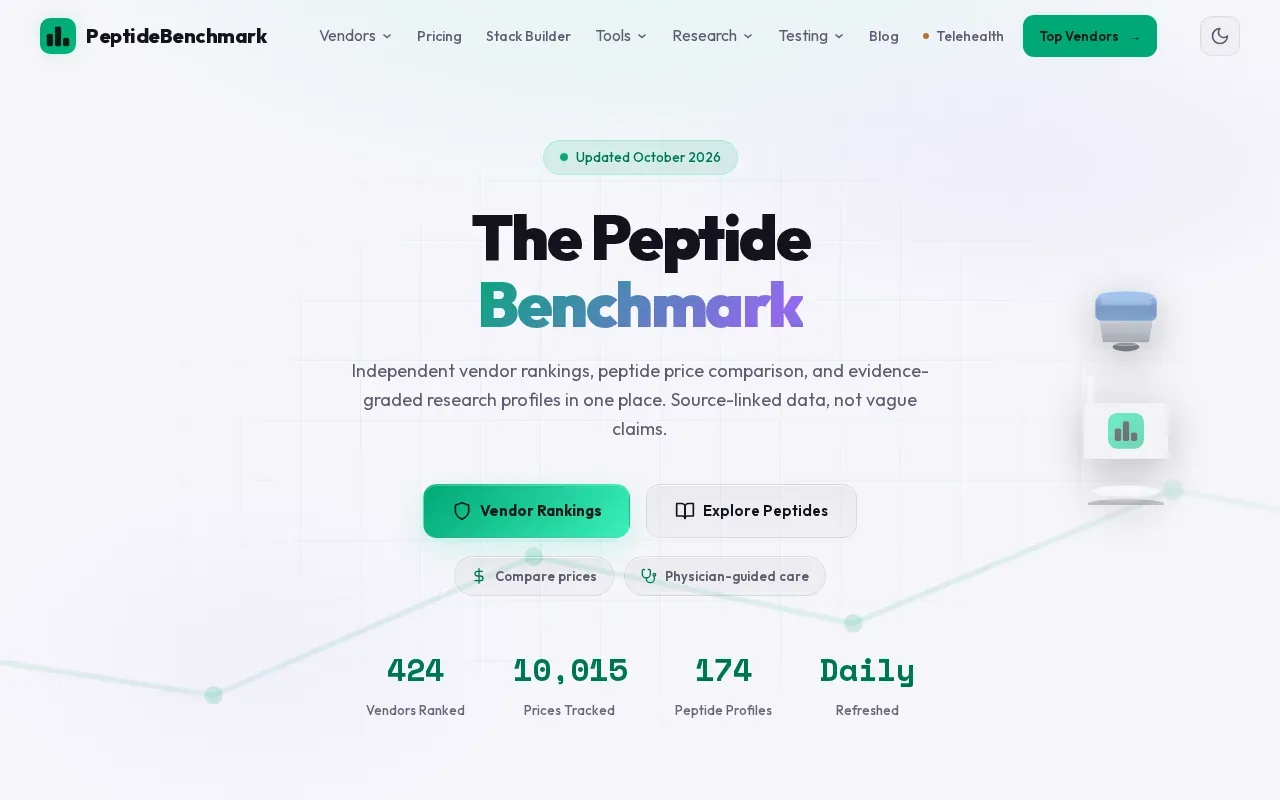
Its public-report focus is useful when you want to inspect evidence instead of relying on a general “tested” claim. PeptideBenchmark says certificates can be searched by vendor, compound, lab, batch, tested panel, and verification status. It also reports certificates confirmed at issuing labs for some products. Those are platform-reported figures; check the linked report details for the specific item you’re assessing.
A public COA can help a buyer follow the evidence trail, but it needs to match the product and batch in question. Check whether the report names the same compound, whether the tested amount matches the offer, and what the test panel covers. A result for one batch does not automatically establish the contents of a later batch.
Also note that PeptideBenchmark says some placements are sponsored, while stating that sponsorship does not affect its scores or ranking order. That disclosure gives readers a detail to consider when interpreting the page. It does not prove that a vendor is suitable for a particular research project.
Choose this option when inspectable testing records are a central part of your review. Pair its evidence view with a current package price, and keep any quality assessment tied to the actual report rather than a vendor’s broad claim.
Research peptide price comparison: how the sites differ
The main difference is what each site puts in front of you. PeptideTech centers exact-package comparisons for U.S. suppliers, while the other sites emphasize unit-price comparisons, seller records, or public testing evidence. None of those views replaces checking the source offer and its date.
| Site | Useful when you need | What to verify next |
|---|---|---|
| PeptideTech | Exact package prices, cost per mg, availability, discounts, and batch documentation | Supplier checkout total, code eligibility, and report-to-batch match |
| Pro Peptide Price | Indexed package formats, unit costs, and estimated partner-code savings | Offer verification notes and whether a code changes checkout cost |
| Disclosed Labs | Prices with seller records and FDA-status information | Specific product status and the supplier’s current listing |
| PeptideBenchmark | Vendor evidence and public COA records | Report identity, batch match, and test scope |
For an example of why package matching matters, PeptideTech’s current listings show different unit prices across product sizes. Its peptide database can help locate recorded package and supplier details, but use the listed observation date when judging whether a price is current.
Forms matter too. Research listings may use vials, powders, capsules, sprays, or blends. Don’t treat oral, injectable, or topical products as interchangeable, and don’t use a price comparison as personal-use guidance. This article doesn’t provide routes of administration or dosing instructions.
For evidence checks, separate research findings from product claims. A result in a lab or animal study does not establish a human effect. A human report does not automatically prove safety or efficacy for a different formulation, route, or population. Price is one procurement detail, not a measure of research value.
PeptideTech lists exact packages and supplier details for comparison.
FAQ
How do I compare research peptide prices fairly?
Compare the same compound identity, form, amount, and market. Then divide the package price by its total milligrams to calculate cost per mg. Keep that figure beside the full package cost, since a larger package can lower unit cost while raising the amount paid upfront. Add shipping, tax, and only verified discounts to estimate the checkout total.
Does a lower price per mg mean a better offer?
No, a lower price per mg only means the listed package costs less per unit of weight. It does not establish identity, purity, measured content, sterility, or suitability for a study. Confirm the exact package and inspect the supplier’s evidence. Also check whether the price is current and whether shipping or a code changes the total.
What should I check on a peptide COA?
Check that the report names the relevant compound and batch, then review its date, lab, and test methods. Look at what the panel actually measured. A purity result alone does not establish identity or content, and a report that cannot be tied to the listed batch offers limited evidence about that package. A supplier’s COA and independently authenticated evidence are not the same thing.
Are research-use-only peptides approved for human use?
A research-use-only label does not mean a product is approved for human use. Check the status of the specific medicine or compound through relevant official records, and don’t infer approval from a comparison listing or seller claim. Research product comparisons are for procurement context; they are not medical advice or instructions for self-administration.
Conclusion
For a clear starting point, use PeptideTech to compare exact packages, then verify the offer and batch evidence with the supplier. Your next step: record the package, price date, and final checkout cost before making a procurement decision.