
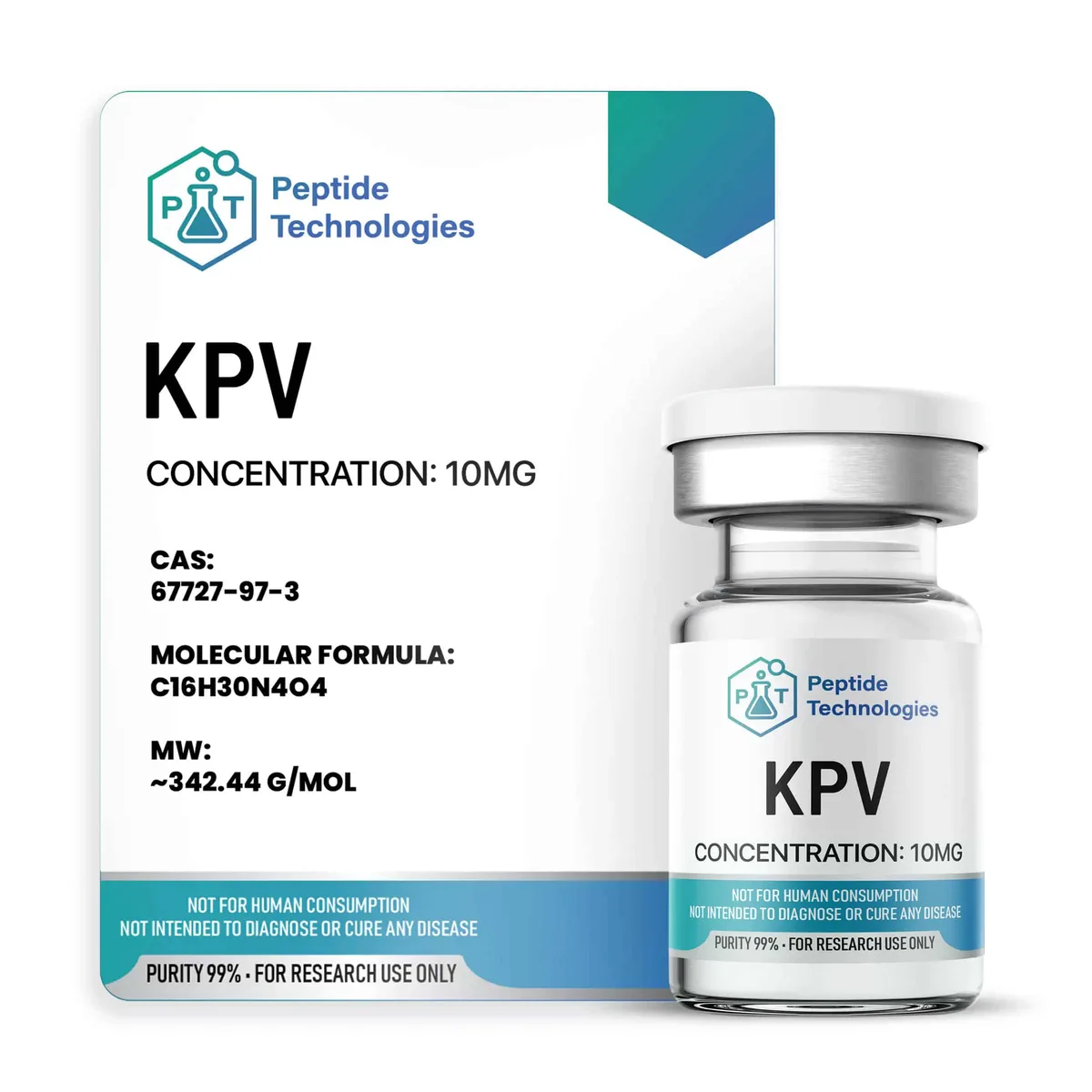
Research use only. Not for use in humans or animals. All products and information on this site are provided strictly for in-vitro laboratory research purposes and are supplied as research chemicals only.
What Is KPV? A Research Peptide Overview
KPV is a short tripeptide corresponding to the C-terminal sequence (lysine-proline-valine) of alpha-melanocyte-stimulating hormone (α-MSH). It is one of the more studied small peptides in inflammation-model and cell-signaling research. This overview covers what KPV is, what researchers study it for, and how to verify research-grade material.
KPV at a glance
| Property | Value |
| --- | --- |
| Name | KPV |
| Sequence | Lys-Pro-Val (Lysine-Proline-Valine) |
| Parent molecule | C-terminus of α-MSH |
| Molecular formula | C₁₆H₃₀N₄O₄ |
| Appearance | White lyophilized powder |
| Intended use | Laboratory research only |
Research background
KPV is the terminal tripeptide fragment of α-MSH, a signaling peptide studied for its role in pigmentation and inflammatory-pathway research. Investigators isolated the KPV sequence because it appears to retain activity in certain inflammation-model assays without the full α-MSH molecule. As a result, KPV is widely used as a reference peptide in cell-signaling and mucosal-model research.
What KPV is studied for
In laboratory research (cell-culture and non-clinical model systems), KPV is studied for its role in:
- Inflammatory-pathway research — NF-κB and cytokine signaling in cultured cell models.
- Mucosal and epithelial models — barrier-function and cell-behavior studies in vitro.
- Peptide-fragment pharmacology — how a short C-terminal fragment behaves relative to the parent α-MSH.
All of this is laboratory research; KPV offered here is a research chemical only, supplied for in-vitro and non-clinical study.
How research-grade KPV is verified
Every batch that ships from a credible US supplier should arrive with a third-party Certificate of Analysis (COA) for that exact lot. Peptide Technologies publishes a COA on every batch and ties it to a QR code on the vial. A complete COA reports:
- Identity — mass spectrometry (ESI-MS) confirming the observed mass matches the theoretical mass of the target compound.
- Purity — reverse-phase HPLC, reported as percent peak area (typically at 220 nm). Research-grade material is ≥98–99% by area.
- Net content — gravimetric confirmation the vial holds the stated mass within tolerance.
- Endotoxin — LAL assay below research thresholds, where applicable.
If a vendor cannot show you a lot-specific COA, you cannot verify what is in the vial. Browse the public COA library →
How to source research-grade material
For laboratory research, sourcing quality comes down to a few checks:
- Lot-specific COA from an accredited, independent laboratory — not a generic marketing PDF.
- HPLC purity ≥98% by peak area, with the chromatogram shown.
- US synthesis and finishing, so the chain of custody is documented end to end.
- Cold-chain shipping for lyophilized material, so the product arrives stable.
Peptide Technologies meets each of these and shows the live competitor price on every product page. See how our pricing compares →
FAQ
What is KPV?
KPV is a tripeptide (Lys-Pro-Val) corresponding to the C-terminus of α-MSH. It is studied in inflammation-model and cell-signaling research and is supplied as a research chemical for laboratory use only.
Is KPV related to α-MSH?
Yes. KPV is the C-terminal tripeptide sequence (Lys-Pro-Val) of alpha-melanocyte-stimulating hormone. Researchers study it as a short fragment of that larger signaling peptide.
Is KPV legal to buy for research?
KPV is sold by Peptide Technologies for laboratory research use only (RUO). It is not an approved drug, dietary supplement, cosmetic, or food. Buyers must affirm research use and accept the Terms of Sale at checkout. Not for use in humans or animals.
Is KPV FDA approved?
No. KPV is not approved by the FDA and is not intended to diagnose, mitigate, or prevent any condition. It is supplied strictly as a research chemical for laboratory use only.
How is KPV verified?
Research-grade KPV is verified by RP-HPLC for purity, by mass spectrometry for identity, and — where applicable — by an LAL endotoxin assay, all reported on a lot-specific third-party Certificate of Analysis.
Where can I buy KPV for research?
You can buy KPV online directly from Peptide Technologies at peptidetech.is, with a third-party COA, cold-chain shipping, and lot traceability on every batch. View the KPV product page →