
A BPC-157 price comparison can show a wide gap between a low per-milligram figure and a listing with useful batch evidence. PeptideTech, PepFinder, Pro Peptide Price and MyPeptidePrice take different approaches to supplier and price details. Here’s what each can help you check, and what to confirm before using a displayed price to plan a research purchase.
1. PeptideTech
PeptideTech is a self-serve comparison site for U.S. research peptide suppliers. It shows exact-package pricing, cost per milligram, stock status, verified discounts and batch documentation. It fits buyers who want to compare the same product amount while keeping supplier evidence in view.
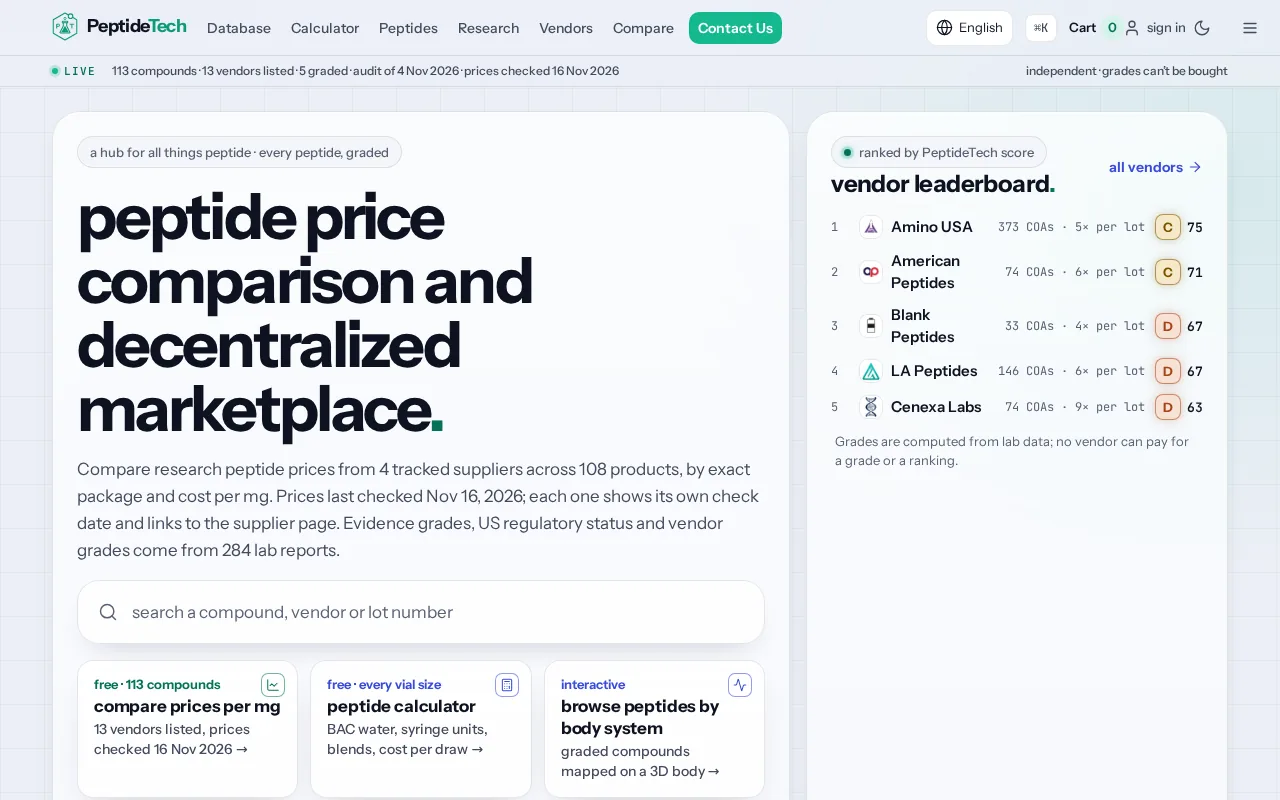
In a BPC-157 snapshot dated November 17, 2026, PeptideTech showed a price of $5.67 per mg alongside 10 lab reports. PeptideTech’s $5.67-per-mg price is near the overall median of $5.30, while the lowest reported offer was $0.50 per mg. The gap is a reason to inspect the evidence beside the price, not a claim that a higher price guarantees a better product.
PeptideTech’s product pages also show package-level prices and cost per mg. Its homepage includes examples for other peptide listings, such as a 10 mg vial at $58 and a 100 mg vial at $50. Those examples are not BPC-157 prices, so don’t use them as substitutes when comparing BPC-157. Match the named compound and package first.
Stock status is useful when a buyer is checking whether a quoted package appears available. It still isn’t a promise that the supplier will have the item at checkout. Confirm the exact product and current inventory with the supplier before you place an order. The same goes for a discount: a referral code is not the same as a verified coupon with a confirmed checkout price.
PeptideTech does not sell or ship the listed products. A purchase is made with the supplier, through a supplier link or code. Some links or codes may be affiliate arrangements, so treat the comparison as a research aid rather than an independent laboratory endorsement. Partner-order assistance is available at no extra charge, but the supplier remains responsible for the order.
For a wider look at package matching and supplier records, see the research peptide price comparison sites overview. When a lab needs to compare like-for-like offers, start with the labeled amount and then check whether the listing has batch evidence tied to the product.
2. PepFinder
PepFinder is a comparison resource that centers supplier evaluation as well as price. The available description says it compares research peptide suppliers using testing transparency, customer reviews, business information and independent research. It may suit buyers who want to review supplier signals alongside a product listing.
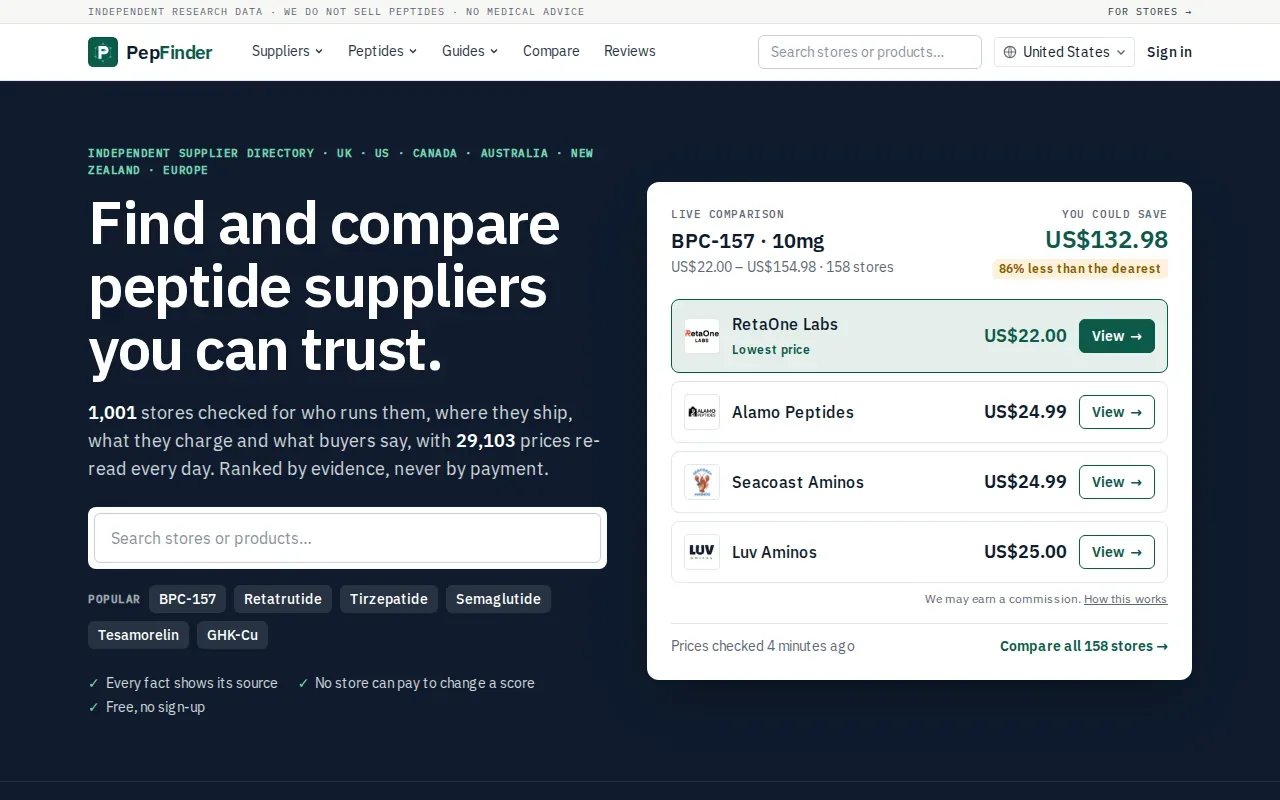
That mix matters because a price alone tells you little about what evidence supports a listing. A supplier’s stated testing policy, a report for a specific batch and an independently checked result are different things. Review each item on its own terms. A policy is not proof that the vial you might receive has the same test record.
Customer reviews can help identify themes in buyer feedback, but they don’t establish product identity or measured content. Business information can help you understand who is selling the product. Neither replaces a report that identifies the tested material and connects it to a batch or lot.
The core decision is whether the supplier details answer the questions your lab has. Check if a listed report names a lab and date. Then see whether it identifies a batch. Purity results describe a sample’s relative target signal; they do not establish the total amount of material in the vial. Nor does a purity result establish sterility or suitability for any use.
PepFinder’s supplier-evaluation approach includes independent research, but that does not guarantee the quality of every vendor or product. Check the evidence shown for the exact listing you’re considering. If the listing’s supplier has a testing claim, see whether the page points to a report and whether the report matches the product identity and batch details.
For buyers comparing sellers as well as price sites, see the supplier comparison.
PepFinder is a useful fit when supplier transparency is a larger part of the decision than finding the lowest displayed number. Keep review scores separate from lab evidence, and keep both separate from a supplier’s own claims.
3. Pro Peptide Price
Pro Peptide Price compares research peptide prices across indexed partner vendors. Listings include package sizes, verified cost per mg, regular prices and estimated savings from partner codes. It is suited to buyers who want a price comparison that distinguishes a standard price from a possible code-based reduction.
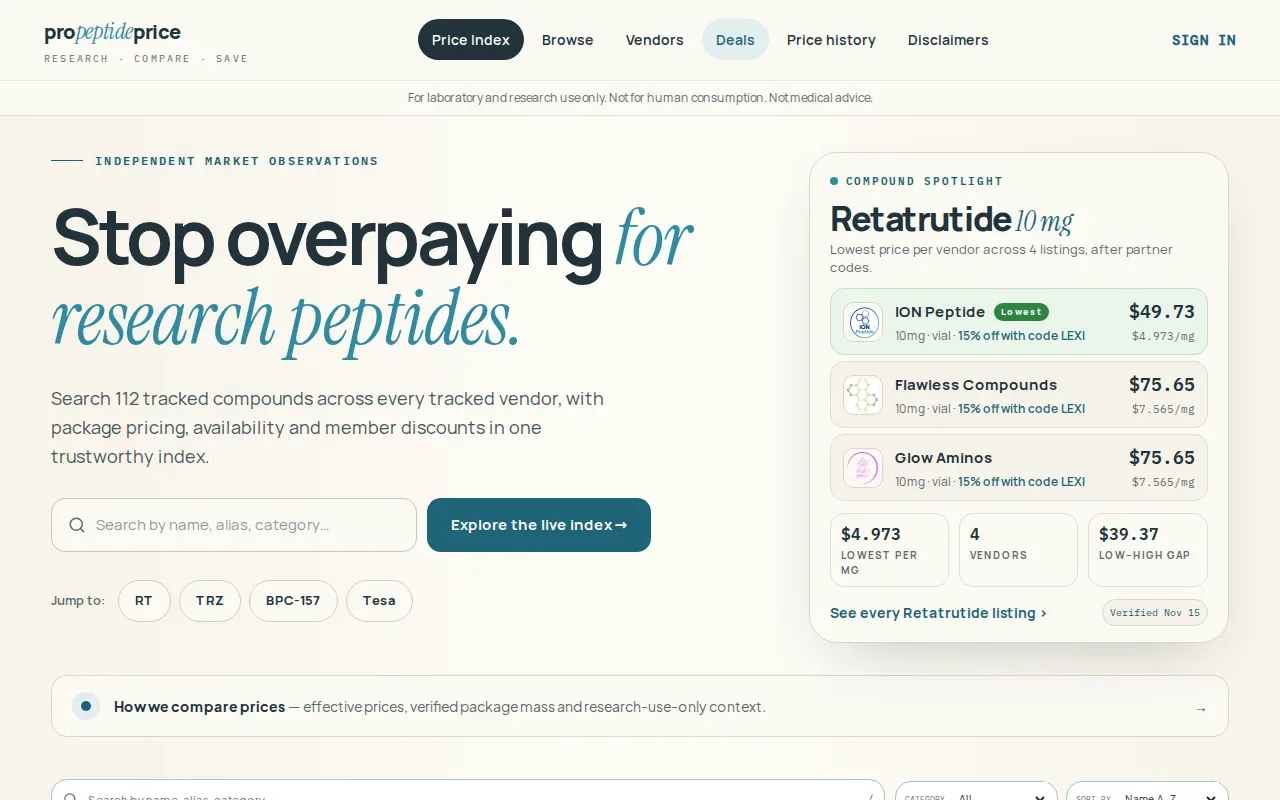
That distinction can change a budget. A regular package price is one figure. A displayed partner-code estimate is another. Don’t treat the estimate as the amount you will pay until the code applies to the exact product and package in the supplier’s checkout. If it depends on an order minimum or other condition, include that condition in your comparison.
Cost per mg is a simple calculation: divide the package price by the labeled milligrams. For example, a hypothetical $60 package containing 10 mg works out to $6 per mg. This is arithmetic, not a quality grade. It also doesn’t account for shipping, tax or other checkout charges, so it cannot stand in for the delivered cost.
Package size affects this calculation. A larger vial may show a lower unit cost, but the total package price may be higher. A buyer who only needs a small amount for a defined laboratory project could spend more by choosing a larger package just to lower the per-milligram figure. Compare the amount your project requires with the supplier’s package, rather than treating unit cost as the only decision rule.
Some price-comparison services use partner relationships. Pro Peptide Price lists indexed partner vendors and estimated partner-code savings. That is useful context: a code estimate is not the same as a price verified in your cart, and a partner listing does not establish supplier quality. Keep the source price, code terms and final checkout total in separate fields in a lab purchasing record.
For another explanation of package math, see the cost-per-milligram comparison guide. The main rule stays simple: compare the same compound, form and labeled quantity before using the per-mg result to rank costs.
Pro Peptide Price is most useful when a buyer wants to see how an estimated partner code changes a listed price. Record the normal price too, so a future reviewer can tell which figure depends on a promotion.
4. MyPeptidePrice
MyPeptidePrice compares cost per mg across 17 vendors as a research peptide comparison site. It shows live pricing, current sales and coupon codes separately. That separation can help buyers tell a standard price from a promotional price or code-based offer.
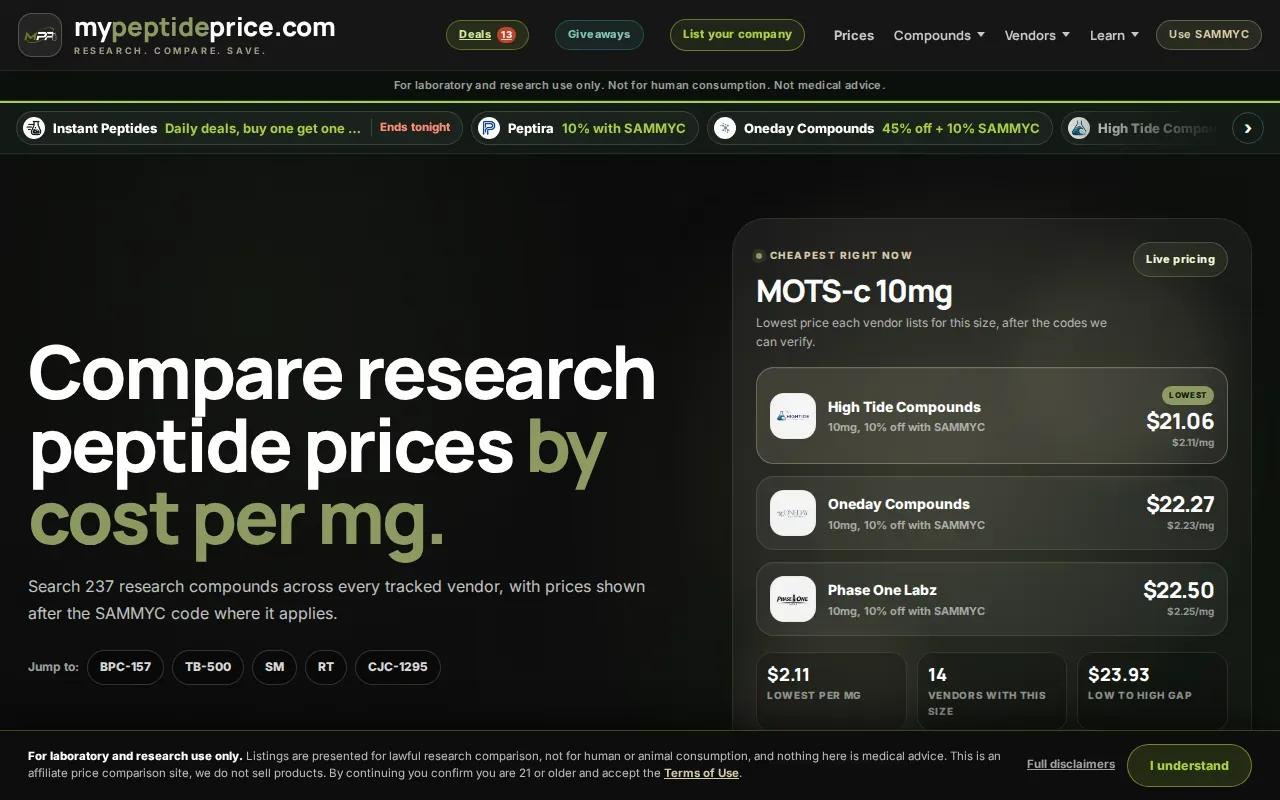
Separate fields are helpful because sales and codes can have different terms. A sale may apply to only some package sizes. A coupon may have an expiry date or a minimum order. Before using either in a budget, check that the offer applies to the exact BPC-157 listing you’re evaluating and confirm the resulting price with the supplier.
The term “live pricing” describes the site’s pricing approach, but a displayed figure still needs a date and a product match. Prices can change between a comparison page and checkout. Keep a dated note or screenshot for the offer you considered, and verify the final amount at the point of purchase.
For a meaningful comparison, don’t combine different vial sizes into one average. A 5 mg vial and a 10 mg vial have different package costs even when their per-mg values are close. Check the exact quantity, then compare the listed price per mg. If you’re comparing blended products or different forms, don’t treat them as equivalent to a single-ingredient BPC-157 listing.
Promotions also don’t provide evidence about product identity, batch testing or the amount measured in a vial. Check those details separately. When a report is available, confirm that it names the compound and gives information that links it to the lot or batch. A supplier’s general testing statement does not answer that batch-specific question by itself.
MyPeptidePrice’s separate treatment of live pricing, sales and coupon codes gives budget-minded buyers a clear reason to check the promotion details. Keep a second figure for the regular price. That makes it easier to compare offers after a sale ends.
BPC-157 Price Comparison: Features That Change the Result
A low cost per mg does not settle the buying decision. BPC-157 offers range from $0.50 to $26 per mg. Some very low-price listings had no batch documentation in that snapshot. A lower number may come from a larger package, but size alone does not tell you what evidence supports the product.
Some suppliers priced at $2 to $6 per mg included lab documentation, but price range alone does not establish stronger evidence. Check the report itself, the test date and whether the batch details match the offered material. A certificate of analysis, or COA, should be read for what it measures, not treated as a general safety stamp.
| What to compare | Why it changes the decision | What to record |
|---|---|---|
| Product identity and form | Different compounds, blends or forms are not like-for-like offers. | Exact name, form and labeled amount. |
| Package price and cost per mg | A lower unit cost can come with a higher total package price. | Package price, milligrams and calculated unit cost. |
| Batch documentation | A general supplier claim may not identify the lot being offered. | Report date, batch or lot, and stated test result. |
| Stock and price date | A displayed offer may not match checkout availability or cost. | Observation date and supplier confirmation. |
| Discount and delivered total | A code estimate may not include shipping, tax or offer conditions. | Eligible code, final checkout price and added charges. |
PeptideTech’s listing was marked in stock, but buyers should still confirm availability directly with the supplier. Treat a site’s recorded status as a dated reference, not a delivery promise.
Purity and measured content answer different questions. An HPLC purity result describes a sample’s relative purity under the stated method. LC-MS can support identity analysis. Neither result alone proves the vial contains the labeled total amount. Check what was tested and whether the record can be tied to the relevant batch.
A research-vendor price also can’t be compared directly with a clinic program or commercial product if the quote includes a different service, product status or delivery arrangement. Compare the same scope and package. The available figures here are not a basis for estimating a monthly regimen or a full treatment course. No dosing plan is provided, and a price per mg is not a treatment recommendation.
Coverage and rules depend on the product and use. Don’t assume an insurer will cover a research-use listing or treat a vendor price as a medical-care quote. For general context, the FDA explains how dietary supplements are regulated; that category should not be assumed to include every research product. Athletes should check the rules that apply to their sport before using any substance.
For a compound-to-compound comparison, see PeptideTech’s BPC-157 and TB-500 comparison.
FAQ
How do I compare BPC-157 prices per mg?
Divide the package price by the labeled milligrams to calculate cost per mg. Compare only the same compound and form, and keep each package size separate. Then check whether a discount is confirmed and whether shipping or tax changes the final total. A lower per-mg figure is a price measure, not evidence of product quality.
Does a low BPC-157 price mean the product is lower quality?
No, price alone does not establish product quality. A low figure may reflect a larger package or other pricing terms, while a high figure does not prove a product has better evidence. Review the product identity and any available batch report. Check what the lab measured and whether the report matches the batch being offered.
Can I use these prices to estimate a monthly cost or full course?
Not responsibly without a defined, appropriate research quantity and a matching package. A price per mg only supports unit-cost math; it does not set a dose or treatment plan. This comparison does not provide dosing instructions or a personal-use regimen.
Are BPC-157 research products covered by insurance?
Don’t assume that an insurance plan will cover a research-use product. Coverage depends on the product and the plan, and a vendor listing is not a medical-care quote. Check the plan’s written terms for a specific product and use. If you’re evaluating treatment, speak with a licensed health professional about lawful, approved options.
What should athletes check before considering a peptide?
Athletes should check the current rules for their sport and the official prohibited-substance list that applies to them. Product labels and supplier claims do not establish that a substance is permitted. Confirm requirements with the relevant governing body.
Conclusion
For a side-by-side view of package cost and supplier evidence, start with PeptideTech, then verify the exact listing and current checkout details with the supplier. Keep price, discount terms and batch documentation in the same purchasing record. Use research peptide price-comparison sites to inform your review.