
A low cost per milligram can hide a package that’s much larger than your lab needs. For example, the lowest advertised rate in one U.S. comparison snapshot was $0.65 per mg, but it applied to an 80 mg package. These comparison sites can help you find a starting point, as long as you check the exact product and final purchase cost.
We analyzed 51 comments and questions from Reddit, YouTube and Quora about peptide cost per milligram and found that 29% mentioned purity verification.
1. PeptideTech
PeptideTech is a self-serve comparison site for research peptide listings from U.S. suppliers. It shows exact-package pricing, cost per milligram, stock availability, verified discounts, and batch documentation. It’s suited to research buyers who want to compare a specific package before opening a supplier’s checkout page.
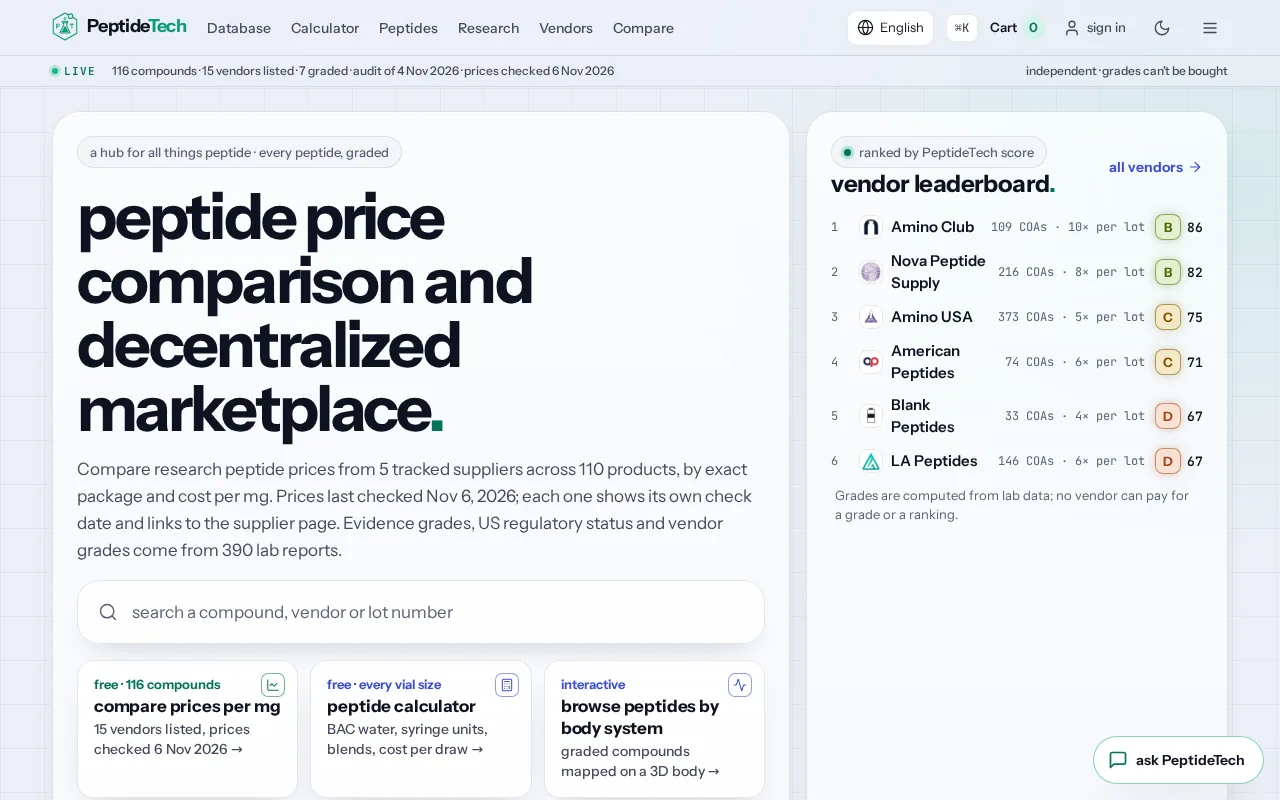
Keep product identity and package size fixed while comparing. A price per mg only helps when the listings refer to the same compound and form. For example, an 80 mg package and a 10 mg package may have very different unit prices, even when both display a low-looking total. PeptideTech’s exact-package view helps make that difference visible.
Supplier records also matter. A listing’s batch document is evidence to inspect, not proof that PeptideTech tested the material. Check whether a certificate of analysis, or COA, names a lab and connects to the batch being sold. Purity is one measurement; it does not by itself establish identity, measured content, sterility, or suitability.
For category-specific comparisons, use the site’s GLP-1 peptide listings as a starting point, then confirm the exact form and package on the supplier’s page. Purchases happen with suppliers. PeptideTech may earn a commission through referral links or codes, and partner-order assistance is available at no extra charge.
PeptideTech fits buyers who want package, availability, discount, and batch-document details in one comparison workflow. Check the supplier’s current page before purchase, since displayed prices and stock can change.
2. Pro Peptide Price
Pro Peptide Price compares research peptide prices and package sizes across indexed partner vendors. Its stated comparison includes cost per mg, regular prices, and estimated partner-code savings. It may suit a buyer who wants to scan partner listings and then verify the offer directly with the supplier.
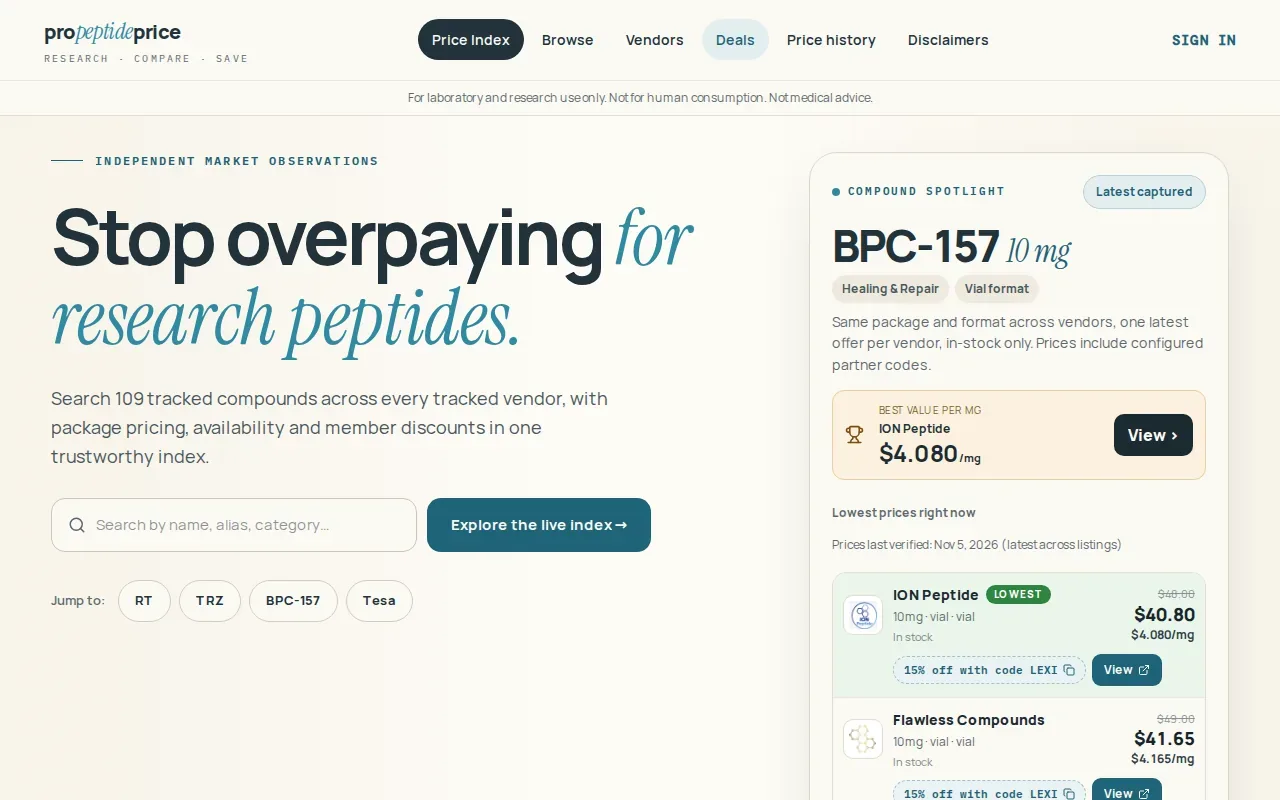
Treat a displayed code and an applied discount as separate facts. An estimated saving does not establish that a code applies to your product or checkout. Compare the regular listed price first. Then test the code against the exact package and note the final price shown before payment.
Package matching still matters. A 10 mg vial and a multi-vial kit are not comparable by the price of one vial alone. Confirm total labelled milligrams and multiply the price per vial by the number of vials when needed. The same calculation applies to any discount, but only after the supplier accepts it.
Pro Peptide Price describes its listings as indexed partner vendors, so treat the site’s results as a comparison set rather than a complete market census. For a broader explanation of package math, see how to compare peptide vial size with total cost.
3. PepFinder
PepFinder presents median listed prices per mg for validated listings. Its price page separates U.S. dollar pricing from other currencies and gives the middle half of listings alongside the median. It’s a useful reference when you want a market range rather than a single seller’s rate.
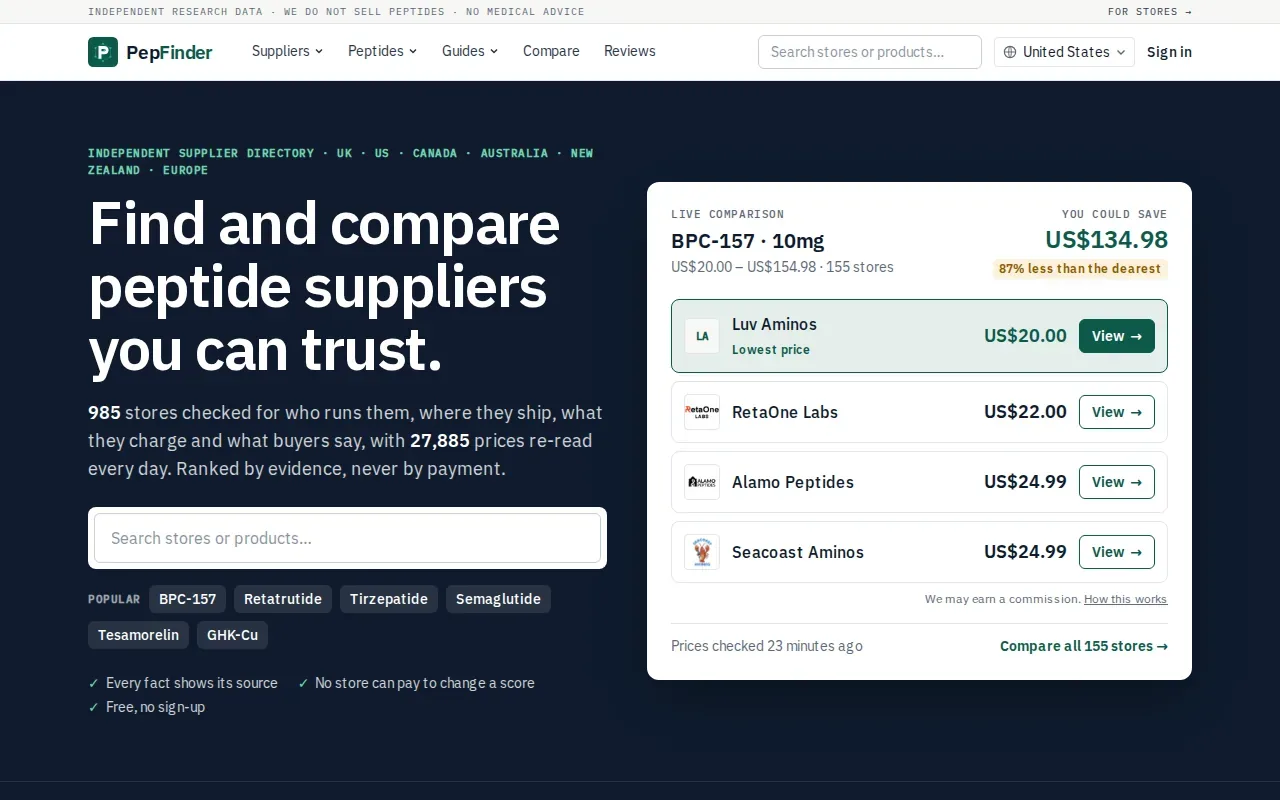
PepFinder says a peptide appears in its price results after it has at least five listings from three suppliers. That rule gives the comparison a minimum spread of listings, but it also means a less commonly listed peptide may not appear there. The site’s price information is a reference point, not a guarantee that a particular listing remains available.
A November 5, 2026 snapshot illustrates how strongly package size can affect the displayed rate. Hacker Peptides advertised $0.65 per mg for an 80 mg package. By contrast, EZ Peptides Official showed a 10 mg vial at $35, or $3.50 per mg. The lower unit rate requires a much larger package, so the right comparison depends on the quantity the lab needs.
That same snapshot included a $26 per mg listing for a 1 mg package from Limitless Biotech. Four suppliers with standard 10 mg packages fell between $2.40 and $3.50 per mg. These are dated observations, not a promise of current stock or checkout pricing. PepFinder last read its website on November 5, 2026.
4. PeptidePrices
PeptidePrices is another named price-comparison option for buyers to consider. It may belong in an initial search when you want to see whether the exact compound and package you need appear in a comparison directory.
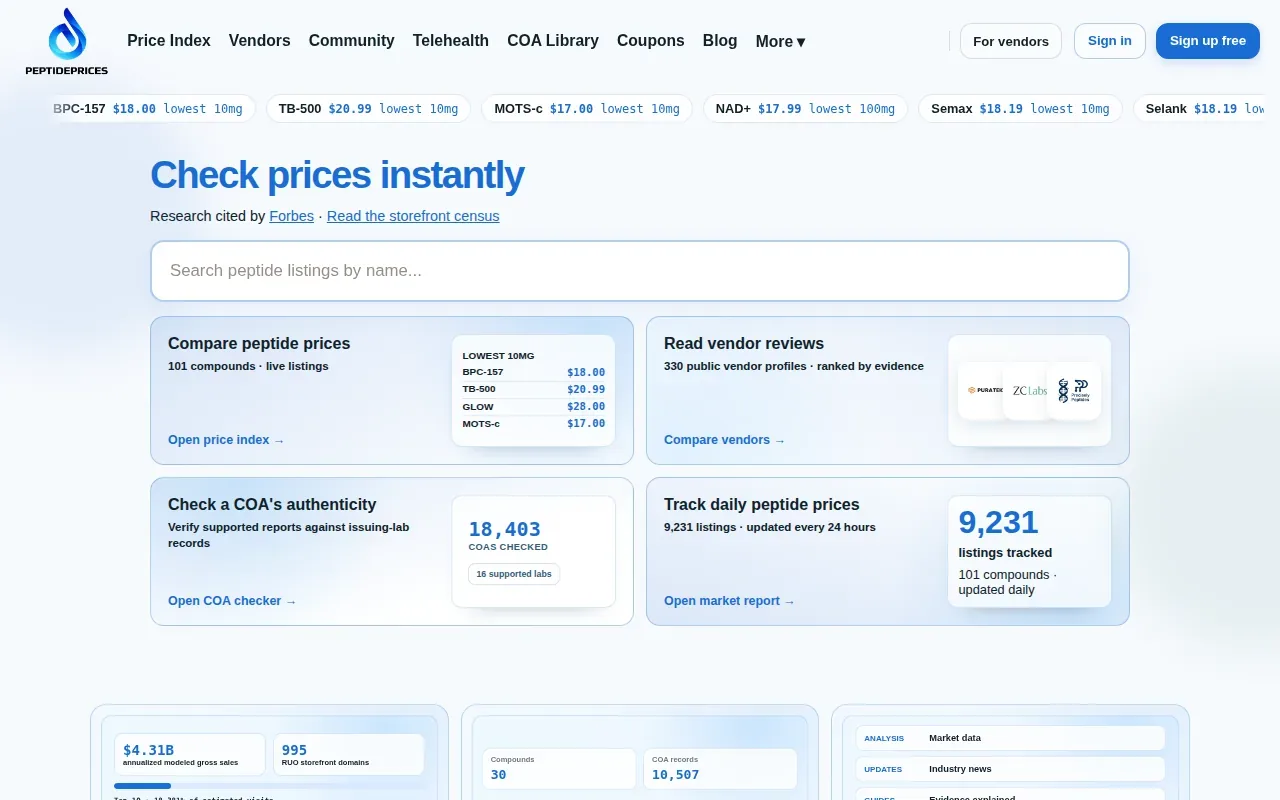
Use a directory result as a lead, not as a purchase record. Open the supplier’s own page and match the product name, form, package count, and labelled amount. If any of those differ, the per-mg figure may not represent the item your team plans to buy.
Keep a simple record of the price observation date and the supplier page used. That lets a second buyer or procurement reviewer repeat the check later. It also prevents a past rate from being mistaken for today’s offer.
5. Pepticker
Pepticker is a comparison resource with a published explainer on reading peptide prices per milligram. It’s relevant when a buyer needs a plain-language reference for interpreting unit-price figures before comparing listings.
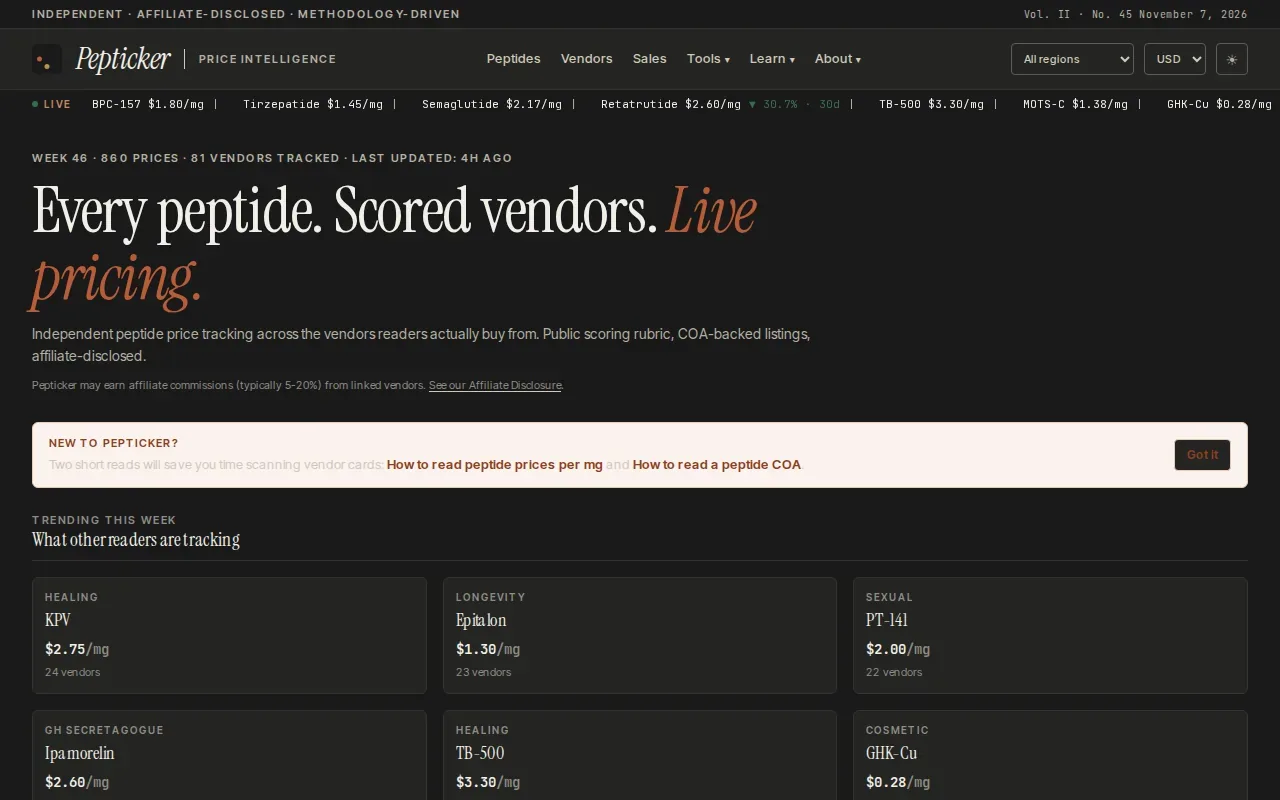
Use its explanation as a prompt to check the underlying listing. Make sure the price and milligrams refer to the same package. If a listing combines multiple vials, use the total amount across the pack rather than the amount in one vial.
A site’s method for displaying price does not replace supplier evidence. Keep stock confirmation, discount eligibility, and batch documentation as separate checks. A referral link can lead to a seller, but it does not verify a discount or confirm the item will ship.
Compare the Shortlist: Coverage, Price Evidence, and Fit
The most useful site depends on the question you need answered. PeptideTech combines package pricing with availability, verified discounts, and batch documentation. PepFinder supplies a median and spread for qualifying listings. Pro Peptide Price focuses on indexed partner offers and estimated code savings.
Use the table to choose a starting point, not to treat unlike data as equivalent. Features below reflect the information described for each site. Confirm any product-level detail on the seller’s current page.
| Site | Useful starting point | Evidence to check next |
|---|---|---|
| PeptideTech | Exact-package price, cost per mg, stock, discounts, and batch documents | Supplier listing, batch match, and final checkout total |
| Pro Peptide Price | Indexed partner pricing and estimated partner-code savings | Code eligibility and final supplier price |
| PepFinder | Median price and middle range for qualifying listings | Exact package, price date, and supplier availability |
| PeptidePrices | Another directory to check for a matching product listing | Product identity, package details, and seller page |
| Pepticker | Price-per-mg reading guidance | Listing math and seller documents |
One dated market snapshot reported no stock status, verified discount details, or batch-document availability across its listed supplier entries. Treat that as a warning to verify those fields for each purchase, not as a claim about every vendor or every comparison site. PeptideTech’s directory can help you inspect supplier information, but the supplier remains responsible for its product and order.
For another view of displayed per-mg offers, check research peptide prices by displayed cost per milligram. Read the page’s date and discount conditions before treating any rate as current.
How to Read Cost per mg and the Real Purchase Cost
Cost per mg is the listed package price divided by the total labelled milligrams in that package. It is a unit price, like other measures of cost per unit; Wikipedia’s unit-price definition describes the same basic comparison idea. For peptide listings, the calculation only helps when the products match.
Use this formula:
Package price ÷ total labelled milligrams = listed cost per mg
For a $35 package containing 10 mg, the calculation is $35 ÷ 10 = $3.50 per mg. That example matches the dated EZ Peptides Official listing cited above. It excludes shipping, taxes, and any checkout fees, so it is not the delivered cost per mg.
To compare the full basket, add the current shipping charge and mandatory fees to the package total. Then divide by the total labelled milligrams in all packages. If the supplier applies a discount, use the final eligible price shown at checkout. Do not subtract a code that has not been accepted.
Like-for-like means the same compound, form, quantity basis, market, and currency. A blend, capsule, salt, or different variant may not be comparable to a single-ingredient vial. A lower price per mg also says nothing by itself about product identity or purity.
Read a COA for what it actually measures. HPLC purity describes a purity result. LC-MS can support an identity assessment. Neither measurement alone confirms the labelled quantity or establishes sterility. Check whether the report connects to the batch being sold, and keep the source record with the price observation.
For the meaning of this unit-price measure, the price-per-mg glossary entry gives a short reference. The compound itself is a chain of amino acids, as described in Wikipedia’s overview of peptides. That definition does not make distinct products or forms interchangeable.
FAQ
How do I calculate peptide cost per mg?
Divide the package price by the total labelled milligrams in the package. For example, a $35 package with 10 mg costs $3.50 per mg before shipping or fees. For a multi-vial pack, add the milligrams across all vials first. Keep the result separate from landed cost, which includes required checkout charges.
Does the lowest price per mg mean the best value?
No. A low unit price can require a much larger package than your work needs. A dated listing at $0.65 per mg applied to an 80 mg package, while a 10 mg listing was $3.50 per mg. Compare the amount you need and the full checkout cost before judging value.
What should I check on a peptide COA?
Check the named lab, reported test methods, measured results, and whether the document matches the supplier’s batch. Purity and identity are separate questions, and neither alone proves the labelled amount or sterility. Treat a vendor’s claim, an available COA, and independently authenticated batch evidence as different levels of evidence.
Do peptide comparison sites show the final price?
Not always. A displayed unit price may exclude shipping, taxes, mandatory fees, or a discount that has not been accepted at checkout. Add the costs that apply to your destination, then divide the final basket total by the package’s total labelled milligrams. Keep the displayed price and final cost as separate figures.
How often should I recheck a peptide price?
Recheck the supplier’s page before placing an order. A directory observation has a date, while stock and checkout terms can change later. Record the date you checked, the package size, and the price shown. If a discount affects the comparison, confirm that the supplier accepts it for the exact item.
Conclusion
Use PeptideTech when you want to compare exact packages alongside supplier availability, discount details, and batch documentation. Then verify the listing and final basket total with the seller. Compare peptide price sites and supplier evidence before your next procurement review.