Home / Research library / LGD-4033
LGD-4033: molecular data, studies & sources
LGD-4033 is catalogued here as a research compound. This profile brings together the molecular source record, selected indexed publications and available supplier comparisons. Evidence for a named substance does not authenticate a commercial product.
Compiled by PeptideTech Editors · Sources checked · Selected bibliography, not a systematic review
Molecular formula, weight & structure
- Molecular formula (MF)
- C14H12F6N2O
- Molecular weight (MW)
- 338.25 g/mol
- PubChem compound ID
- 44137686
- Record title
- Vk-5211
Values describe the selected PubChem molecular entity. Counterions, salt forms, hydration and sequence changes can alter the supplied material. Confirm the exact identity against the supplier specification.
Source: PubChem CID 44137686 · retrieved 2026-10-09
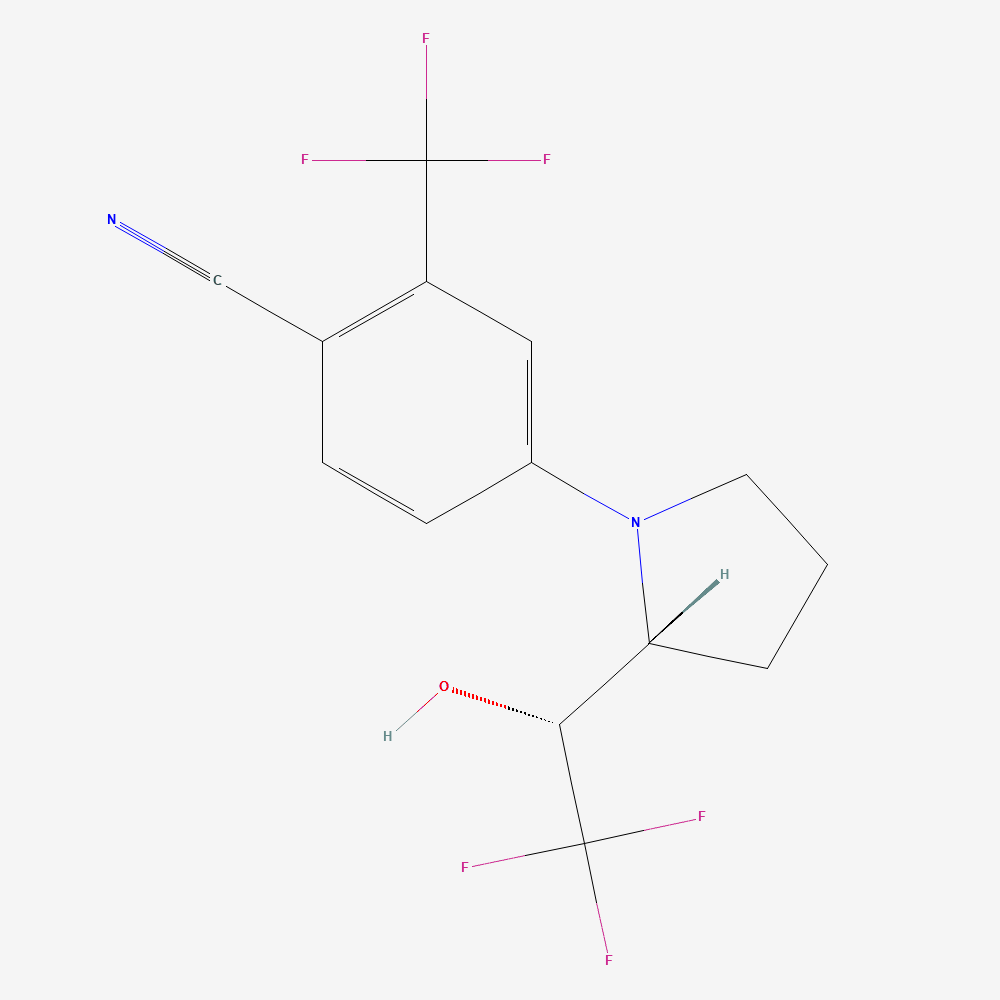
Chemical identifiers and source data
- IUPAC name
- 4-[(2R)-2-[(1R)-2,2,2-trifluoro-1-hydroxyethyl]pyrrolidin-1-yl]-2-(trifluoromethyl)benzonitrile
- InChIKey
- OPSIVAKKLQRWKC-VXGBXAGGSA-N
- SMILES
- C1C[C@@H](N(C1)C2=CC(=C(C=C2)C#N)C(F)(F)F)[C@H](C(F)(F)F)O
Identifiers
- PubChem CID
- 44137686
- CAS Registry Number
- 1165910-22-4via ChemIDplus, EPA DSSTox, FDA GSRS
- FDA UNII
- 1EJT54415A
- ChEMBL ID
- CHEMBL5170587
- InChIKey
- OPSIVAKKLQRWKC-VXGBXAGGSA-N
- Wikidata
- Q21098841
CAS numbers are published only from ChemIDplus, EPA DSSTox or the FDA Global Substance Registration System; UNII codes are confirmed in FDA GSRS by structure, sequence or exact name. Checked 2026-10-09.
Calculated molecular descriptors
| Monoisotopic (exact) mass | 338.0854 Da |
|---|---|
| Heavy atoms | 23 |
| Hydrogen-bond donors | 1 |
| Hydrogen-bond acceptors | 3 |
| Rotatable bonds | 2 |
| Topological polar surface area | 47.3 Ų |
| Calculated logP (Crippen) | 3.47 |
| Rings | 2 |
| Stereocenters | 2 |
| Formal charge | 0 |
Computed with RDKit from the published SMILES (Crippen logP, topological polar surface area). Calculated descriptors are not measured properties of a supplied batch.
US regulatory status & drug development
Drug development record (ChEMBL)
Harmonized drug-development record from ChEMBL. The highest clinical stage is the furthest stage reached, as recorded by ChEMBL; it can lag regulatory approvals, and it is not an approval of a research-supplier product.
- ChEMBL ID
- CHEMBL5170587
- Modality
- Small molecule
- Highest clinical stage
- Phase 2
- Record name
- VK5211
Mechanism of action
- Androgen Receptor modulator · target: Androgen receptor (AR)
Synonyms, codes and trade names
- Synonyms and development codes
- LGD-4033
Identity check: Identical standard InChIKey to the PubChem record. Source: ChEMBL CHEMBL5170587 (EMBL-EBI, CC BY-SA 3.0) · retrieved 2026-10-09
Registered clinical trials
Studies registered on ClinicalTrials.gov that list LGD-4033 as an intervention. Studies that only measure the molecule as a biomarker, or use it only as a comparator or background arm for another drug, are excluded. A registration describes a planned or completed protocol; it does not report a result. Active studies are listed first.
1 registered study matched, 1 with results posted on ClinicalTrials.gov.
- By highest phase
- Phase 2 · 1
- By registry status
- Completed · 1
| Study | Phase · status | Conditions | Sponsor · size |
|---|---|---|---|
| Acute Hip Fracture Study in Patients 65 Years or GreaterNCT02578095 · start 2015-10-30 · primary completion 2017-11-15 | Phase 2CompletedResults posted 2025-12-29 | Hip Fractures | Viking Therapeutics, Inc.108 participants |
Registry check 2026-10-09 · Run this search on ClinicalTrials.gov
Human intervention studies
Selected studies in which participants received LGD-4033, with their indexed or reviewed study type. Check the original article for the formulation, population and controls. Studies that only measured the molecule, or used it as a comparator, are listed separately below and are not counted as intervention studies.
- Human study · PubMed trial index Compound given to participants
The safety, pharmacokinetics, and effects of LGD-4033, a novel nonsteroidal oral, selective androgen receptor modulator, in healthy young men.
Basaria S, Collins L, Dillon EL et al. · The journals of gerontology. Series A, Biological sciences and medical sciences · 2012
PMID 22459616 · DOI: 10.1093/gerona/gls078
Preclinical research, reviews & other publications
Animal studies, laboratory experiments, reviews and other indexed papers answer different questions. A review is secondary evidence; a case report does not estimate how often an outcome occurs.
- Preclinical / laboratory research
Ostarine and Ligandrol Improve Muscle Tissue in an Ovariectomized Rat Model.
Roch PJ, Henkies D, Carstens JC et al. · Frontiers in endocrinology · 2020
PMID 33042018 · DOI: 10.3389/fendo.2020.556581
- Research publication · design requires review
Variation of Sequential Ligandrol (LGD-4033) Metabolite Levels in Routine Anti-Doping Urine Samples Detected with or without Other Xenobiotics.
Kwiatkowska D, Wicka M, Grucza K et al. · Molecules (Basel, Switzerland) · 2023
PMID 37764261 · DOI: 10.3390/molecules28186486
- Case report
LGD-4033 and MK-677 use impacts body composition, circulating biomarkers, and skeletal muscle androgenic hormone and receptor content: A case report.
Cardaci TD, Machek SB, Wilburn DT et al. · Experimental physiology · 2022
PMID 36303408 · DOI: 10.1113/EP090741
- Research publication · design requires review
Human in vivo metabolism study of LGD-4033.
Fragkaki AG, Sakellariou P, Kiousi P et al. · Drug testing and analysis · 2018
PMID 30255601 · DOI: 10.1002/dta.2512
- Research publication · design requires review
Effects of ligandrol as a selective androgen receptor modulator in a rat model for osteoporosis.
Hoffmann DB, Derout C, Müller-Reiter M et al. · Journal of bone and mineral metabolism · 2023
PMID 37407738 · DOI: 10.1007/s00774-023-01453-8
- Preclinical / laboratory research
Ligandrol Ameliorates High-Fat Diet- and Streptozotocin-Induced Type 2 Diabetes Mellitus and Prevents Pancreatic Islets Degeneration.
Sugumar D, Ghosh R, Rymbai E et al. · Assay and drug development technologies · 2024
PMID 39501873 · DOI: 10.1089/adt.2024.029
- Research publication · design requires review
Investigations into the elimination profiles and metabolite ratios of micro-dosed selective androgen receptor modulator LGD-4033 for doping control purposes.
Wagener F, Guddat S, Görgens C et al. · Analytical and bioanalytical chemistry · 2021
PMID 34734312 · DOI: 10.1007/s00216-021-03740-7
LGD-4033 supplier sources
Scientific sources describe molecules and experiments. The commercial links below identify recorded supplier packages. A publication or chemical database entry does not verify the seller, purity, sterility or contents of a lot. Some links are affiliate links; see our disclosure.
No priced supplier offers are currently available in this catalog view. The research record remains available independently of stock.
Reference sources & further reading
- PubChem compound record 44137686 — chemical identity and structure.
- ChEMBL drug record CHEMBL5170587 — development stage, mechanism and synonyms.
- FDA Global Substance Registration System: UNII 1EJT54415A — substance identity, names and codes.
The citations above link directly to publication records. Encyclopedia links are background reading and are not used to establish clinical effectiveness.
Search for additional research
These links run searches; their results have not been individually reviewed and can include unrelated compounds.
Research information is not a dosing guide or a recommendation for personal use. Study findings are specific to the formulation, population and methods tested. Read our source and correction policy.
Related research profiles
Andarine (S4)
C19H18F3N3O6
441.4 g/mol · PubChem CID 9824562
5 selected publications · 0 human intervention studies
Cardarine
C21H18F3NO3S2
453.5 g/mol · PubChem CID 9803963
8 selected publications · 0 human intervention studies · 3 registered trials
Small molecule · highest stage: Phase 2
MK-677
C27H36N4O5S
528.7 g/mol · PubChem CID 178024
4 selected publications · 4 human intervention studies · 4 registered trials
Small molecule · highest stage: Phase 2
MK-777 (Acetamoren)
Molecular identity needs further verification
Source verification pending
0 selected publications · 0 human intervention studies
Ostarine
C19H14F3N3O3
389.33 g/mol · ChEMBL CHEMBL1738889
8 selected publications · 0 human intervention studies · 17 registered trials
Small molecule · highest stage: Phase 3
RAD-140
C20H16ClN5O2
393.8 g/mol · PubChem CID 44200882
8 selected publications · 0 human intervention studies · 1 registered trial
Small molecule · highest stage: Phase 2