Home / Research library / Methylene Blue Solution
Methylene Blue Solution: molecular data, studies & sources
Methylene Blue Solution is catalogued here as a research compound. This profile brings together the molecular source record, selected indexed publications and available supplier comparisons. Evidence for a named substance does not authenticate a commercial product.
Compiled by PeptideTech Editors · Sources checked · Selected bibliography, not a systematic review
Molecular formula, weight & structure
- Molecular formula (MF)
- C16H18ClN3S
- Molecular weight (MW)
- 319.9 g/mol
- PubChem compound ID
- 6099
- Record title
- Methylene Blue
Values describe the selected PubChem molecular entity. Counterions, salt forms, hydration and sequence changes can alter the supplied material. Confirm the exact identity against the supplier specification.
Source: PubChem CID 6099 · retrieved 2026-09-21
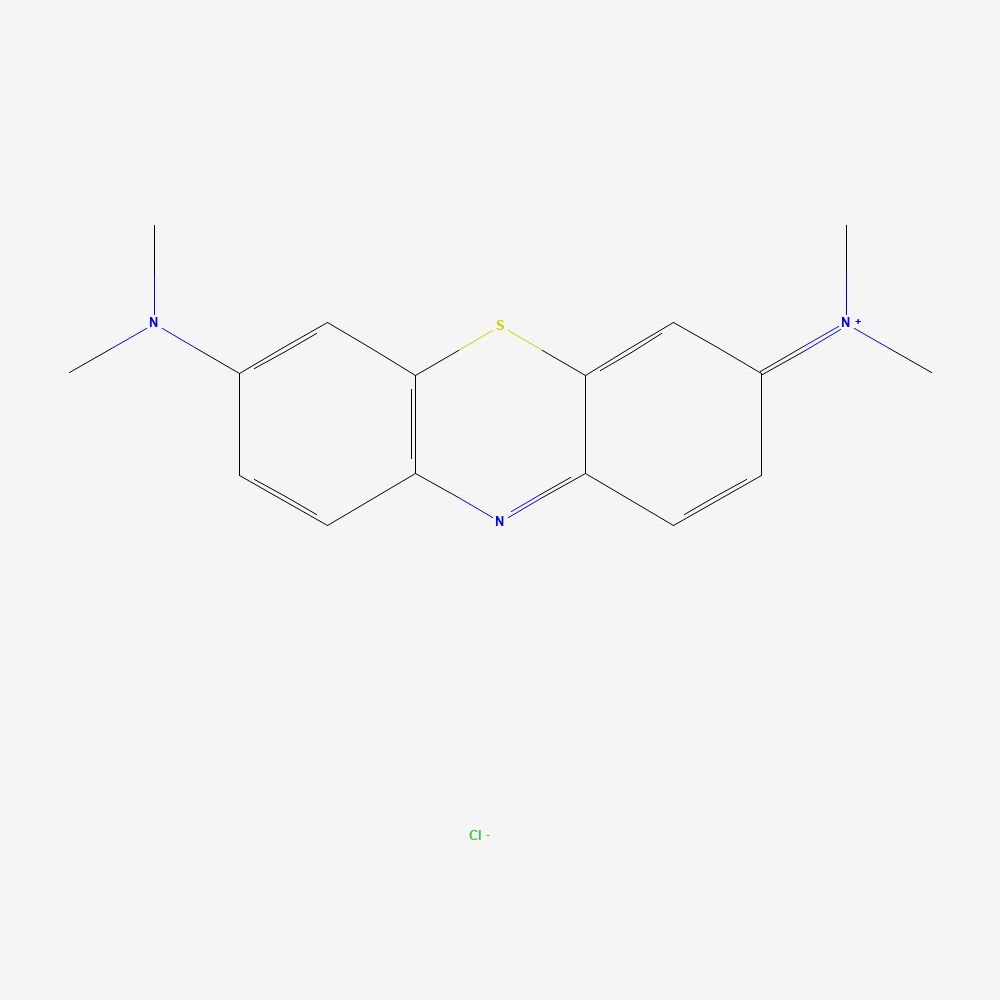
Chemical identifiers and source data
- IUPAC name
- [7-(dimethylamino)phenothiazin-3-ylidene]-dimethylazanium chloride
- InChIKey
- CXKWCBBOMKCUKX-UHFFFAOYSA-M
- SMILES
- CN(C)C1=CC2=C(C=C1)N=C3C=CC(=[N+](C)C)C=C3S2.[Cl-]
Human and clinical studies
Selected human-study records are shown with their indexed or reviewed study type. Check the original article for the intervention, formulation and controls; the molecule can also be a comparator or measured variable.
- Human study · PubMed trial index
Early adjunctive methylene blue in patients with septic shock: a randomized controlled trial.
Ibarra-Estrada M, Kattan E, Aguilera-González P et al. · Critical care (London, England) · 2023
PMID 36915146 · DOI: 10.1186/s13054-023-04397-7
- Human study · PubMed trial index
Infusion of methylene blue in human septic shock: a pilot, randomized, controlled study.
Kirov MY, Evgenov OV, Evgenov NV et al. · Critical care medicine · 2001
PMID 11588440 · DOI: 10.1097/00003246-200110000-00002
Preclinical research, reviews & other publications
Animal studies, laboratory experiments, reviews and other indexed papers answer different questions. A review is secondary evidence; a case report does not estimate how often an outcome occurs.
- Review · secondary evidence
The Potentials of Methylene Blue as an Anti-Aging Drug.
Xue H, Thaivalappil A, Cao K et al. · Cells · 2021
PMID 34943887 · DOI: 10.3390/cells10123379
- Review · secondary evidence
Methylene-blue-associated encephalopathy.
Sweet G, Standiford SB · Journal of the American College of Surgeons · 2007
PMID 17324781 · DOI: 10.1016/j.jamcollsurg.2006.12.030
- Research publication · design requires review
Methylene blue: revisited.
Ginimuge PR, Jyothi SD · Journal of anaesthesiology, clinical pharmacology · 2010
PMID 21547182
Methylene Blue Solution supplier sources
Scientific sources describe molecules and experiments. The commercial links below identify recorded supplier packages. A publication or chemical database entry does not verify the seller, purity, sterility or contents of a lot. Some links are affiliate links; see our disclosure.
Compare all Methylene Blue Solution sizes, forms and supplier prices →
| Supplier | Recorded packages | Example source listing |
|---|---|---|
| Amino USAUSD | 10mg-per-mL-30mL Solution1 recorded offers | 10mg-per-mL-30mL Solution · $18.00Checked Sep 16, 2026Supplier listing |
Reference sources & further reading
- PubChem compound record 6099 — chemical identity and structure.
- Wikipedia: Methylene blue — Background encyclopedia; not a primary clinical source.
The citations above link directly to publication records. Encyclopedia links are background reading and are not used to establish clinical effectiveness.
Search for additional research
These links run searches; their results have not been individually reviewed and can include unrelated compounds.
Research information is not a dosing guide or a recommendation for personal use. Study findings are specific to the formulation, population and methods tested. Read our source and correction policy.
Related research profiles
ACE-031
Molecular identity needs further verification
4 selected publications · 2 human study records
Adipotide
C111H206N36O28S2
2557.2 g/mol · PubChem CID 163360068
0 selected publications · 0 human study records
AICAR
C9H14N4O5
258.23 g/mol · PubChem CID 17513
4 selected publications · 3 human study records
Dermorphin
C40H50N8O10
802.9 g/mol · PubChem CID 5485199
1 selected publications · 1 human study records
Enclomiphene
C26H28ClNO
406.0 g/mol · PubChem CID 1548953
5 selected publications · 3 human study records
Follistatin 344
Molecular identity needs further verification
4 selected publications · 0 human study records