Home / Research library / PNC-27
PNC-27: molecular data, studies & sources
PNC-27 is catalogued here as a research compound. This profile brings together the molecular source record, selected indexed publications and available supplier comparisons. Evidence for a named substance does not authenticate a commercial product.
Compiled by PeptideTech Editors · Sources checked · Selected bibliography, not a systematic review
Molecular formula, weight & structure
- Molecular formula (MF)
- C188H293N53O44S
- Molecular weight (MW)
- 4032 g/mol
- PubChem compound ID
- 16201774
- Record title
- H-Pro-Pro-Leu-Ser-Gln-Glu-Thr-Phe-Ser-Asp-Leu-Trp-Lys-Leu-Leu-Lys-Lys-Trp-Lys-Met-Arg-Arg-Asn-Gln-Phe-Trp-Val-Lys-Val-Gln-Arg-Gly-OH
Values describe the selected PubChem molecular entity. Counterions, salt forms, hydration and sequence changes can alter the supplied material. Confirm the exact identity against the supplier specification.
Source: PubChem CID 16201774 · retrieved 2026-09-21
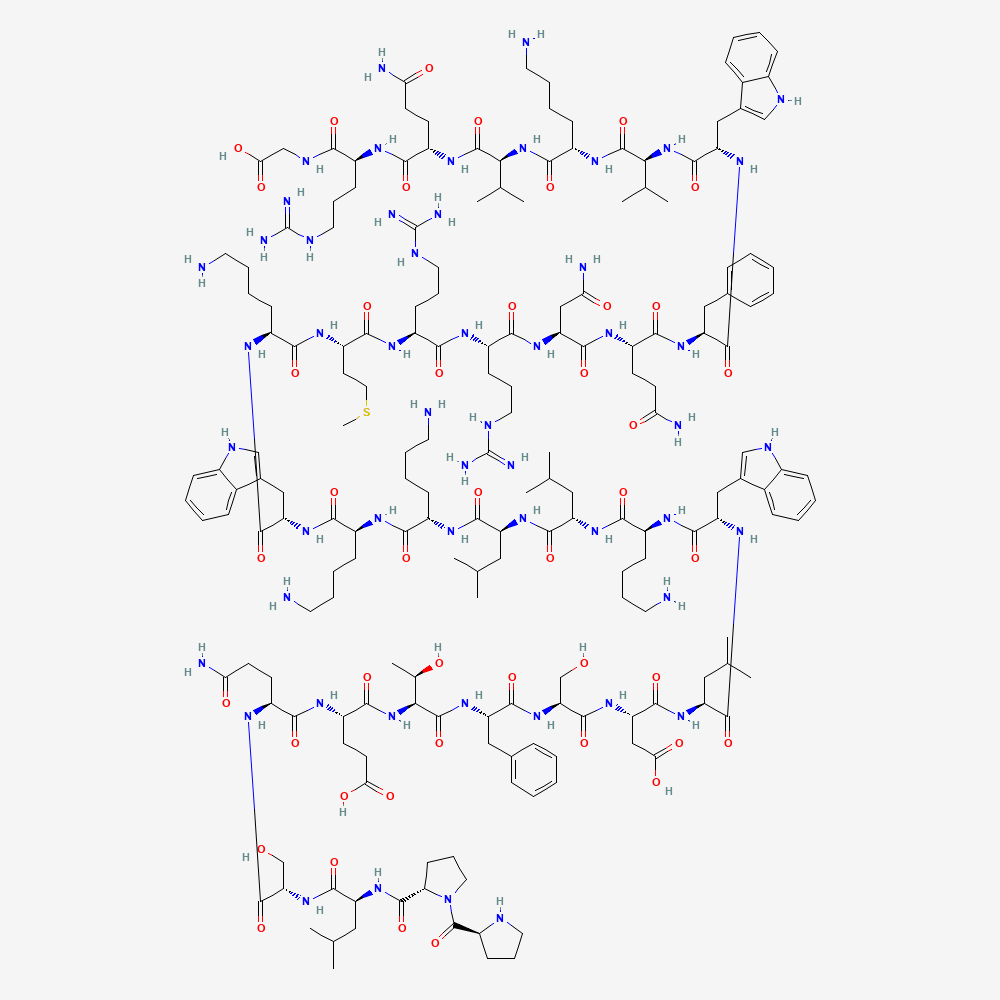
Chemical identifiers and source data
- IUPAC name
- (4S)-5-[[(2S,3R)-1-[[(2S)-1-[[(2S)-1-[[(2S)-1-[[(2S)-1-[[(2S)-1-[[(2S)-6-amino-1-[[(2S)-1-[[(2S)-1-[[(2S)-6-amino-1-[[(2S)-6-amino-1-[[(2S)-1-[[(2S)-6-amino-1-[[(2S)-1-[[(2S)-1-[[(2S)-1-[[(2S)-4-amino-1-[[(2S)-5-amino-1-[[(2S)-1-[[(2S)-1-[[(2S)-1-[[(2S)-6-amino-1-[[(2S)-1-[[(2S)-5-amino-1-[[(2S)-5-carbamimidamido-1-(carboxymethylamino)-1-oxopentan-2-yl]amino]-1,5-dioxopentan-2-yl]amino]-3-methyl-1-oxobutan-2-yl]amino]-1-oxohexan-2-yl]amino]-3-methyl-1-oxobutan-2-yl]amino]-3-(1H-indol-3-yl)-1-oxopropan-2-yl]amino]-1-oxo-3-phenylpropan-2-yl]amino]-1,5-dioxopentan-2-yl]amino]-1,4-dioxobutan-2-yl]amino]-5-carbamimidamido-1-oxopentan-2-yl]amino]-5-carbamimidamido-1-oxopentan-2-yl]amino]-4-methylsulfanyl-1-oxobutan-2-yl]amino]-1-oxohexan-2-yl]amino]-3-(1H-indol-3-yl)-1-oxopropan-2-yl]amino]-1-oxohexan-2-yl]amino]-1-oxohexan-2-yl]amino]-4-methyl-1-oxopentan-2-yl]amino]-4-methyl-1-oxopentan-2-yl]amino]-1-oxohexan-2-yl]amino]-3-(1H-indol-3-yl)-1-oxopropan-2-yl]amino]-4-methyl-1-oxopentan-2-yl]amino]-3-carboxy-1-oxopropan-2-yl]amino]-3-hydroxy-1-oxopropan-2-yl]amino]-1-oxo-3-phenylpropan-2-yl]amino]-3-hydroxy-1-oxobutan-2-yl]amino]-4-[[(2S)-5-amino-2-[[(2S)-3-hydroxy-2-[[(2S)-4-methyl-2-[[(2S)-1-[(2S)-pyrrolidine-2-carbonyl]pyrrolidine-2-carbonyl]amino]pentanoyl]amino]propanoyl]amino]-5-oxopentanoyl]amino]-5-oxopentanoic acid
- InChIKey
- MZCACYLMMMXSKC-KOCFKOPYSA-N
- SMILES
- C[C@H]([C@@H](C(=O)N[C@@H](CC1=CC=CC=C1)C(=O)N[C@@H](CO)C(=O)N[C@@H](CC(=O)O)C(=O)N[C@@H](CC(C)C)C(=O)N[C@@H](CC2=CNC3=CC=CC=C32)C(=O)N[C@@H](CCCCN)C(=O)N[C@@H](CC(C)C)C(=O)N[C@@H](CC(C)C)C(=O)N[C@@H](CCCCN)C(=O)N[C@@H](CCCCN)C(=O)N[C@@H](CC4=CNC5=CC=CC=C54)C(=O)N[C@@H](CCCCN)C(=O)N[C@@H](CCSC)C(=O)N[C@@H](CCCNC(=N)N)C(=O)N[C@@H](CCCNC(=N)N)C(=O)N[C@@H](CC(=O)N)C(=O)N[C@@H](CCC(=O)N)C(=O)N[C@@H](CC6=CC=CC=C6)C(=O)N[C@@H](CC7=CNC8=CC=CC=C87)C(=O)N[C@@H](C(C)C)C(=O)N[C@@H](CCCCN)C(=O)N[C@@H](C(C)C)C(=O)N[C@@H](CCC(=O)N)C(=O)N[C@@H](CCCNC(=N)N)C(=O)NCC(=O)O)NC(=O)[C@H](CCC(=O)O)NC(=O)[C@H](CCC(=O)N)NC(=O)[C@H](CO)NC(=O)[C@H](CC(C)C)NC(=O)[C@@H]9CCCN9C(=O)[C@@H]1CCCN1)O
Identifiers & sequence
- PubChem CID
- 16201774
- InChIKey
- MZCACYLMMMXSKC-KOCFKOPYSA-N
Peptide sequence · 32 residues (one-letter code; X marks a residue without a one-letter code)
PPLSQETFSDLWKLLKKWKMRRNQFWVKVQRG
Condensed notation with terminal groups and non-standard residues
H-Pro-Pro-Leu-Ser-Gln-Glu-Thr-Phe-Ser-Asp-Leu-Trp-Lys-Leu-Leu-Lys-Lys-Trp-Lys-Met-Arg-Arg-Asn-Gln-Phe-Trp-Val-Lys-Val-Gln-Arg-Gly-OH
Source: PubChem Biologic Line Notation. A reference sequence for the record, not an analysis of a supplied batch.
Calculated molecular descriptors
| Monoisotopic (exact) mass | 4029.2040 Da |
|---|---|
| Heavy atoms | 286 |
| Hydrogen-bond donors | 58 |
| Hydrogen-bond acceptors | 51 |
| Rotatable bonds | 136 |
| Topological polar surface area | 1613.5 Ų |
| Calculated logP (Crippen) | -10.29 |
| Rings | 10 |
| Stereocenters | 32 |
| Formal charge | 0 |
Computed with RDKit from the published SMILES (Crippen logP, topological polar surface area). Calculated descriptors are not measured properties of a supplied batch.
Registered clinical trials
Studies registered on ClinicalTrials.gov that list PNC-27 as an intervention. Studies that only measure the molecule as a biomarker, or use it only as a comparator or background arm for another drug, are excluded. A registration describes a planned or completed protocol; it does not report a result. Active studies are listed first.
No registered study naming this compound was matched. This is a documented gap in registry coverage, not proof that no study exists.
Registry check 2026-10-01 · Run this search on ClinicalTrials.gov
Human intervention studies
Selected studies in which participants received PNC-27, with their indexed or reviewed study type. Check the original article for the formulation, population and controls. Studies that only measured the molecule, or used it as a comparator, are listed separately below and are not counted as intervention studies.
No human study that administered this compound was retained in this selected bibliography. This is a documented evidence gap in our selection, not proof that no study exists.
Preclinical research, reviews & other publications
Animal studies, laboratory experiments, reviews and other indexed papers answer different questions. A review is secondary evidence; a case report does not estimate how often an outcome occurs.
- Research publication · design requires review
PNC-27, a Chimeric p53-Penetratin Peptide Binds to HDM-2 in a p53 Peptide-like Structure, Induces Selective Membrane-Pore Formation and Leads to Cancer Cell Lysis.
Sarafraz-Yazdi E, Mumin S, Cheung D et al. · Biomedicines · 2022
PMID 35625682 · DOI: 10.3390/biomedicines10050945
- Research publication · design requires review
Targeting Membrane HDM-2 by PNC-27 Induces Necrosis in Leukemia Cells But Not in Normal Hematopoietic Cells.
Thadi A, Lewis L, Goldstein E et al. · Anticancer research · 2020
PMID 32878773 · DOI: 10.21873/anticanres.14488
- Research publication · design requires review
Conjugated PNC-27 peptide/PEI-superparamagnetic iron oxide nanoparticles (SPIONs) as a double targeting agent for early cancer diagnosis: In vitro study.
Rahmani R, Darroudi M, Gharanfoli M et al. · Iranian journal of basic medical sciences · 2022
PMID 36311203 · DOI: 10.22038/IJBMS.2022.65590.14430
- Research publication · design requires review
Anti-Cancer Peptide PNC-27 Kills Cancer Cells by Unique Interactions with Plasma Membrane-Bound hdm-2 and with Mitochondrial Membranes Causing Mitochondrial Disruption.
Krzesaj P, Adler V, Feinman RD et al. · Annals of clinical and laboratory science · 2024
PMID 38802154
- Research publication · design requires review
Synergy between Paclitaxel and Anti-Cancer Peptide PNC-27 in the Treatment of Ovarian Cancer.
Alagkiozidis I, Gorelick C, Shah T et al. · Annals of clinical and laboratory science · 2017
PMID 28667027
PNC-27 supplier sources
Scientific sources describe molecules and experiments. The commercial links below identify recorded supplier packages. A publication or chemical database entry does not verify the seller, purity, sterility or contents of a lot. Some links are affiliate links; see our disclosure.
PNC-27 for sale: compare prices, sizes and forms from every tracked supplier →
| Supplier | Recorded packages | Example source listing |
|---|---|---|
| Amino USAUSD | 10mg Vial1 recorded offers | 10mg Vial · $149.99Checked Oct 13, 2026Supplier listing, PNC-27 10mg Vial, Amino USA, opens in a new tab |
| Cenexa LabsUSD | 10mg Vial1 recorded offers | 10mg Vial · $205.99Checked Oct 13, 2026Supplier listing, PNC-27 10mg Vial, Cenexa Labs, opens in a new tab |
Reference sources & further reading
- PubChem compound record 16201774 — chemical identity and structure.
The citations above link directly to publication records. Encyclopedia links are background reading and are not used to establish clinical effectiveness.
Search for additional research
These links run searches; their results have not been individually reviewed and can include unrelated compounds.
Research information is not a dosing guide or a recommendation for personal use. Study findings are specific to the formulation, population and methods tested. Read our source and correction policy.
Related research profiles
ACE-031
Molecular identity needs further verification
3 selected publications · 2 human intervention studies · 4 registered trials
Adipotide
C111H206N36O28S2
2557.2 g/mol · PubChem CID 163360068
1 selected publication · 0 human intervention studies
AICAR
C9H14N4O5
258.23 g/mol · PubChem CID 17513
4 selected publications · 3 human intervention studies · 4 registered trials
Small molecule · highest stage: Phase 3
B7-33
Molecular identity needs further verification
4 selected publications · 0 human intervention studies
BAM15 Capsules
Molecular identity needs further verification
8 selected publications · 0 human intervention studies
Dermorphin
C40H50N8O10
802.9 g/mol · PubChem CID 5485199
1 selected publication · 1 human intervention study